The Gruntled Ones

Profiles in Gruntled-ness: Robert

haircut

Today I got a haircut.

I usually don’t splurge on these types of things, but I go to a super fancy curly hair salon in Manhattan. Haircuts are not cheap, but they last for six months so it’s worth it. Because I have relatively unusual (naturally red and curly) hair, trips to the beauty parlor have historically been a bit traumatic. From the time I was four, all the frosted-haired salon ladies would gather around me and ask, “Where did you GET that hair?” My parents both have brown hair and dark eyes, but I was too young to understand or explain recessive genes, and also, didn’t it just grow on my head? Needless to say, I didn’t like all the attention. Not to mention a bad haircut can make me look like an actual clown.

Robert is the only person I trust with my hair. I love his sense of style; he is the kind of guy who can pull off three-piece suits with wooden bow ties and pointy iridescent electric blue leather shoes. He is so in demand that I usually end up having to see him as early as 8:00 am on a Saturday. Getting a haircut from Robert is a transformational experience. He assesses the situation, grabs small sections, twists them and snips. You can make small talk with him, but he is giving your hair laser focused attention; he is transfixed.

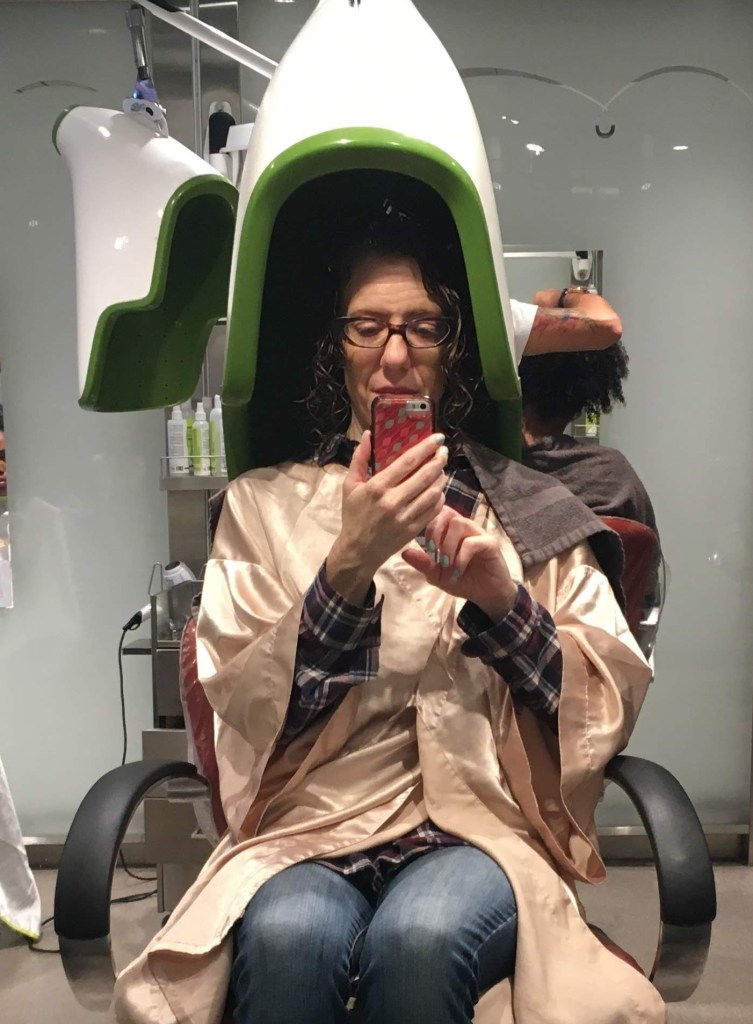
Next is a glorious shampoo deep conditioning and scalp massage, followed by the elaborate ritual of saturating each curl with product and squeezing the curls towards the scalp until they squeak. Then blotting with a microfiber towel and then dozens of tiny alligator clips positioned to add volume to the crown. Under the scary alien hood dryer until I can’t take it anymore and then Robert reappears, digging his hands in to shake out his latest masterpiece. Finally, he asks me to stand up and the real fun begins. He uses his scissor as a level to make sure that the angles are just right. Individual errant strands are surgically snipped. The whole time, he is smiling and staring intently at his work.

Witnessing his Robert’s complete flow-state, I say, “It is so amazing to watch you work. You clearly are doing exactly what you are meant to be doing.” “Thank you sweetheart,” he says (he must have thousands of clients, so the generic nickname is more adorable than offensive), “I do love this work. If it means helping people look and feel little bit better about themselves, to give them a little bit of extra confidence, that makes me happy.” With that, I head off to pay and he’s on to his next sweetheart.

Perhaps this is because I live in New York where most people’s moods range from cynical to hostile, but it is inspiring to encounter people who truly love what they do for a living. Robert is one of the gruntled ones, and he just made this cynical New Yorker’s day.

Uncategorized

Get a hobby! (No, really. Get one!)

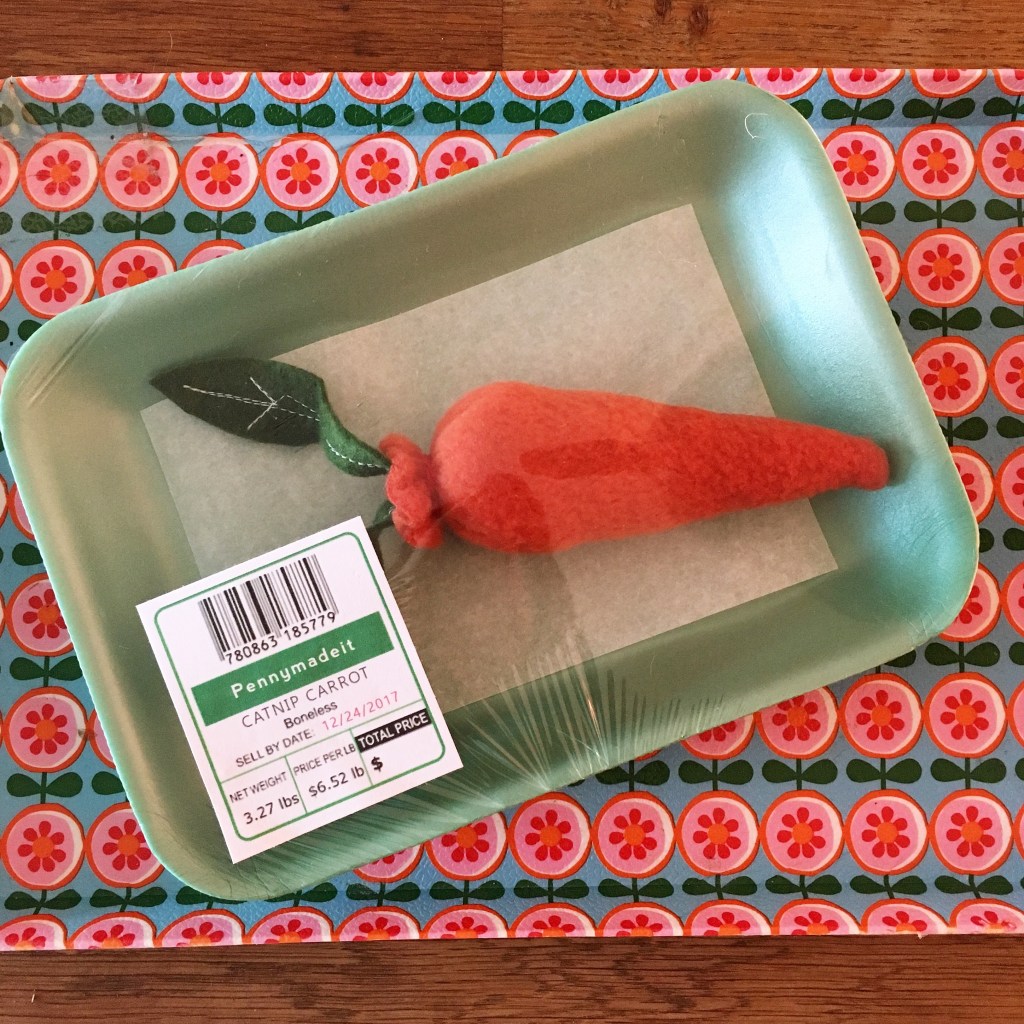
Catnip Carrot.

“I wish *I* had free time!”

I can’t count how many times a friend or coworker has said this to me. It’s usually their response to my response to their question: What did you do this weekend? I flip through my photo feed to find a photo of my latest crafty creation. But where do I get the time? Like my friends, I’m also binge-watching an entire season of Unbreakable Kimmy Schmidt (Unbreakable!), but I’m also doodling or sewing or making a notebook or designing notecards or crocheting a hat or sewing a catnip carrot. The idea of sitting idly while watching television does not work for me. You might think I’m not capable of relaxing, but I’d say this is exactly how I relax. 

Last week I read an article in Business Insider by Shana Lebowitz, who, in an effort to be more “like Warren Buffett and Marissa Meyer,” tries a series of four hobbies over four weeks. She undertakes this challenge not to enjoy herself, but “to be less boring.” She quotes a life coach, a psychologist, and a time management expert, who all agree on the benefits of having outside interests. Lebowitz tries coloring (“I was delighted.”), letter writing (which results in her reconnecting in real life with an old friend), meditation (which she undertakes with a competitive spirit) and cooking and baking (which her coworkers definitely appreciate). When she’s done, she doesn’t really seem too convinced on the benefits of hobbies; she concludes: “I don’t think you need a hobby to be interesting — but I suspect you need a hobby to feel interesting.” Hmph.

According to the Bureau of Labor Statistics, the average American has roughly 5 hours of leisure time per day, and spends about half of that watching TV. The other two and half hours involved socializing, computer use, reading, sports, and “relaxing and thinking.”

So here’s my challenge: try doing something creative during your TV time. Doodle, color, take up knitting. If your hands are busy making things, it’s harder to grab for those Doritos. It’s a win-win.

Uncategorized

Book Review: What are we even doing with our lives?

If Bojack Horseman lived in Portlandia and wrote a children’s book in the style of Richard Scarry, it would look like this.  

what-are-we-doing-cover.jpeg

I stumbled upon the book, What Are We Even Doing with Our Lives? (HarperCollins, 2017), while browsing my local library somewhere between the essays and the humor section. This “most honest ‘children’s’ book of all time” is definitely not for children unless you want them to grow up to be cynical hipsters. It features meticulously detailed two-page spreads of anthropomorphic animals going about their Very Busy Days in a city called “Digi Valley.” I am a huge Richard Scarry fan, so I took the book home and read it in one sitting (I mean, it is a picture book).

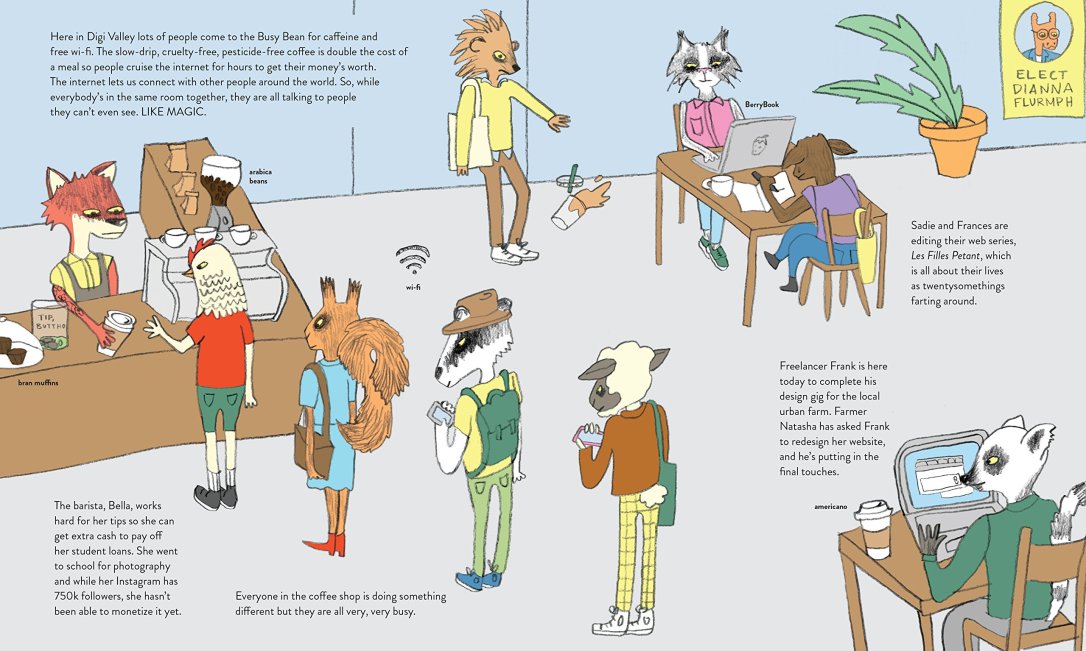
At the Busy Bean Café, we meet characters like Freelancer Frank, Realtor Rick, and Bella the Beauty Blogger, who use the free wifi to communicate with everyone except the people sitting right next to them. Bella the Barista is just trying to pay off her college loans after getting a degree in photography.  She just needs to figure a way to monetize her Instagram feed. Roommates Frances and Sadie rent their extra room on airbnb to “fund their web series while their parents in Indiana pay the rest of the rent.”

cafe-spread.jpg

It’s a sad and hilarious commentary on our use of technology that only further alienates us from each other as we barely manage to get through our days.

But what will our new friends even do with themselves if the Wi-Fi goes down in Digi Valley? 

What Are We Even Doing with Our Lives? was created by real-life best friends Chelsea Marshall (author) and Mary Dauterman (illustrator). Get it at your local independent bookstore!

Uncategorized

obstacles: perfectionism

perfection

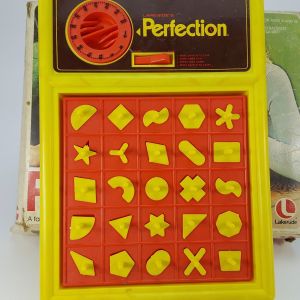
If you were a child in the 80s, you might remember this game.  The word game is very generous to describe this torture device. I received one from my grandmother (for Christmas, no less) in 1982. For the uninitiated, here’s how you play: you empty all of the shapes onto the floor, set the timer, and push down the red tray. You then have exactly 60 seconds to put all of the pieces back before the tray pops up and the yellow shapes go everywhere.  I forgot to mention that while this is happening, the timer offers you a kind reminder in the form of a tick-tick-tick-tick that prepares our youth for a lifetime of high blood pressure.

Look, I’m not going so far as to say that this game had some indelible effect on me, but I would say that I am a bit of a perfectionist. I’m not sure if this is a chicken-or-egg situation, but I do remember also ironing and alphabetizing my money in my youth (fun fact: US currency has a letter on it that corresponds to the city in which it was printed) or obsessively organizing my notebooks for school. In a kid, it’s kind of adorable, but in an adult, not so much. It takes forever to get anything done because nothing is done when your standards are so high.

Fast forward a couple of (okay, maybe three) decades. Right now, I’m a bit paralyzed to  publish anything. Why? It’s not polished enough. It doesn’t accurately or adequately convey the message I am trying to send. But that’s the point of a blog. It’s a sandbox for thoughts and ideas and it is always evolving. It’s iterative. Just like my identity that is constantly under construction and never fixed in one place. Nothing I write will never accurately or adequately capture the essence of who I am because who I am is constantly changing. And that is not the sign of pathology; that is a sign of growth.

I can always tell that I’m anxious when I perseverate over ridiculously minute details. I remember when I first got my last job, I anguished for hours over how to display my work ID. What kind of ID holder what I have? As if this were the ultimate statement on who I am and what type of employee or coworker I would be. I remember trying keychains and around-the-neck lanyards until I finally settled on a retractable reel that I could clip on my clothes even if I didn’t have pockets. But I remember doing hours of Internet research about all of the available options from Etsy to Amazon. What was that all about?

It was my fear of failing at that new job and, now, failing at this “Great Transition” experiment. What if I do all of this and end up just getting a job that pays two-thirds of what I was making before? Or what if I do all of this and in the process, expose myself in some way that makes me un-hireable? Unless I acknowledge my fear, I’m not going to be able to get rid of it.

My rational self would make me answer these questions: what’s the worst that could happen here? And if the worst thing happened, what would that say about me? The worst thing would be not making any progress. It would be telling people that I was going to do this thing, and not accomplish it. But procrastinating because it’s not 100% polished means I have zero percent chance of failing – and zero percent chance of success.

That’s it. I’m hitting ‘publish’ now.

Uncategorized

my old office


old-desk
office of yore

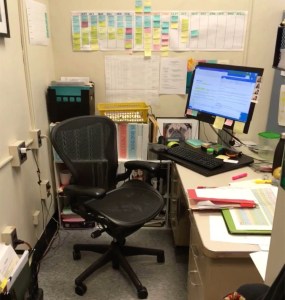
This is where I worked for two years.

My work troubles began with my move from an office to an area previously reserved for file storage. I needed a desk. Scavenging the furniture left behind from another move (read: the garbage), we discovered a 1960s Steelcase tanker.  It was band-aid beige metal with a Formica writing surface and rounded edges.  I loved the kitsch factor – these things sell on eBay for hundreds of dollars.  My boss exclaimed This desk is totally YOU!  It was a feat of industrial design, I had to admit.

My new/old typewriter-era desk was a bit tall, I learned, when I couldn’t find a chair that would adjust high enough or one that was narrow enough to allow me to tuck in without my knees or armrests hitting it. I had to hold my shoulders up to my ears to reach my keyboard, and this began to take a toll on my back and neck.  No problem, I thought, I can fix this.  I just needed the right equipment. Years of classroom teaching had conditioned me to spending money on supplies for my workspace.

After spending eighteen months contending with my body, my office furniture, and my workload, my physical therapist said you need to leave your job. So I did.

Since my shoulders and wrists were starting to hurt, I became obsessed with researching workstation ergonomics.  I approached the problem like a true American: with shopping.  Of course, started my shopping spree with a standing desk ($399).  I bought a split keyboard ($89) and a new mouse ($185). Then I addressed the chair problem, becoming a real-life Goldilocks and the Three Chairs.  The first was industrial-chic: lime green metal with a cool tractor seat ($52).  It adjusted to fit my desk height, but it offered little back support and no cushioning.  The second, a funky hydraulic German-designed “wobble stool,” ($200) also put me in the right position relative to my desk AND it kept my core active.  It was also unstable and offered no back support, so I mostly just wobbled and hunched, slouching into an even worse posture.  The third option, with the help of a U-shaped memory foam sciatica pillow, $29.95) was the closest I would get to “just right,” and even it was still too short by a good two inches. After getting dictation software ($182), I purchased a wireless headphone mic ($228).

I eventually accumulated a series of orthopedic diagnoses. The problem initially manifested as sciatica and neck pain, then made its way down my forearms (tendinitis) to my wrists (carpal tunnel) and hands (deQuarvain’s tenosynovitis) until my tender fingers became so inflamed that I could no longer type. My physical therapist discharged me, convinced that I had arthritis. On my absolute worst day, I cried at my desk and skulked home early, declaring myself “useless” because I could not type at all.

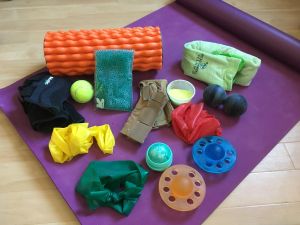
I got a scrip for six weeks of occupational therapy, where I played like a kindergartener with colorful toys and fluorescent putty and dipped my hands in warm paraffin and got what felt like disconcertingly intimate hand massages (YOU try talking to a person you’ve just met when you are face-to-face and she is massaging your hand across a table).  I

PT-toys-2
my toys & braces

accumulated a shoebox full of custom braces, thera-bands, tennis and lacrosse balls and squishy goo.The exercises to stop one problem exacerbated another, like we were playing a game of orthopedic wack-a-mole. My OT would call her colleagues over to ask Why isn’t she getting better? It’s her posture, they said. Try looking at her neck. An MRI confirmed damage to the discs in my C-spine and the beginnings of arthritis in my neck.

But did this also explain my hand pain?

When the steroid injection into my wrist didn’t work, I went to a hand surgeon, who told me it was never carpal tunnel, but rather, tendinitis. He said that I just needed to get stronger and recommended me for something called work hardening.  By that point, I was too frustrated to even figure out what this would entail.  I tried a different orthopedist who tried acupuncture and more physical and occupational therapy.  He recommended an epidural in my neck.  I definitely didn’t want that, so I found a new orthopedist who thinks it’s in my hand muscles and is sending me back to OT.

For the past year, my physical therapist said you need to leave your job. So I did. And here we are.