chronic illness, Productivity, Work tools

Laptop-typing troubles? My recommendation roundup.


screenshot2019-01-31at2.42.44pm
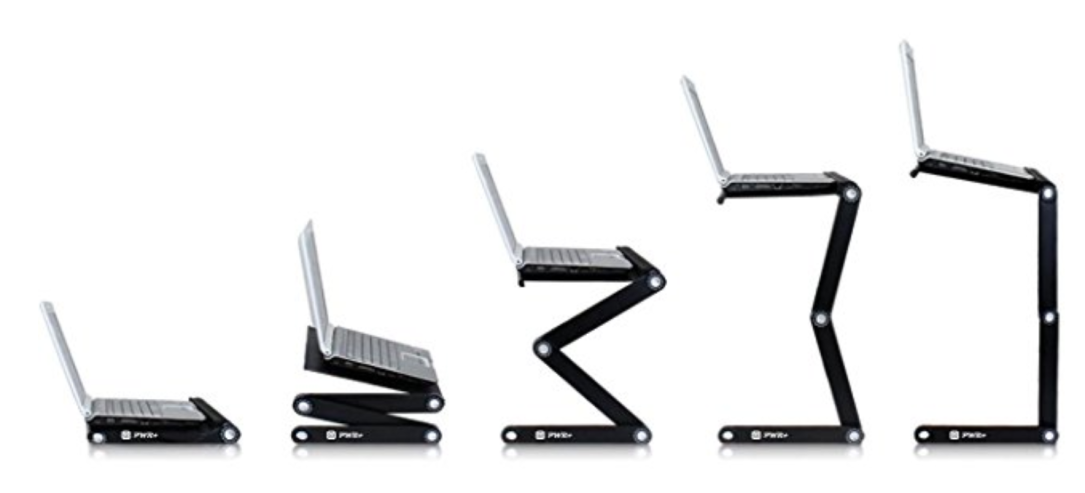
the PWR+ laptop stand.

Yesterday, my constantly-laptop-typing writer friend sent me an email – she had started to feel pain in her hands and arms and was growing alarmed that it might be the beginnings of a repetitive stress injury like the ones I had suffered. Had I ever felt her particular type of pain? Not exactly. But mine was similar enough that I felt compelled to swoop in with recommendations. After nearly two years with vaguely-diagnosable yet completely debilitating pains, I feel like something of an expert. You need a doctor? A physical therapist? An occupational therapist? An acupuncturist who takes insurance? A chiropractor? I can shuffle my stack of medical business cards like a Vegas magician: were you thinking of a massage therapist who also knows reiki? My audience volunteer gasps, YES, I do need one of those!


Where was I? Oh yes. So I resisted the urge to send this friend a 10,000 word email listing everything I have tried for my injuries. Instead, I will share them with you. I guess it would only be fair for me to forward her the link as well, since she inspired this post.

DISCLAIMER: I am NOT a doctor (insert testimonial about consulting your doctor…I am not legally responsible for what happens to you after reading this). I am, however, an informed consumer, so allow me to share some of my favorite tools with you. Oh, and I am not getting any commission here – these are actually the things I use.

ERGONOMICS

  • A laptop stand. Mine has three adjustable hinges and an adorable, removable mouse stand. It can be used as a standing desk, a keyboard rest for an existing monitor setup, or as a monitor stand. Plus it folds! And it weighs only 3.9 pounds!
  • An ergonomic split keyboard. I use the Microsoft Sculpt one with a detached keypad to activate a calculator on your screen. It keeps your arms parallel to  reduce strain on forearm muscles.
  • A decent wireless mouseI use the Logitech M185. I also have the Logitech wireless touchpad, which is like a larger version of the laptop trackpad. It’s good for navigating and zooming but less good for graphic work. I’m considering a vertical mouse, but haven’t made the leap yet.
  • A bean bag wrist wrest. I use the Ergo beads wrist rest to keep my wrists in perfect position for mousing.
  • An memory foam ass pad. Yes, I said ass pad. I have this chair pad. If you must sit at all, this will make it less hurty.

BRACES

  • I was slouching all over the place until I got a back brace. Fatigue can result in sloppy slouches. It is not ideal to use a brace instead of core strength, but the Shark Tank-featured BetterBack brace is really great for this.
  • Wrist splints. I wear these at night to prevent numb hands in the morning. It’s not exactly sexy, but neither is not being able to move your hands.

MUSCLE RELIEF

  • A neck heating pad. OMG. I cannot say enough about this. I got one as a gift from a coworker two years ago and have been using it every day since. I warm my neck up in the morning and again at night before doing my stretches. If you’re particularly crafty, as my mother is, you could make one from cherry pits (she actually bought a barrel of these). The one she gave me smells so good and gives off moist warmth. I overheated a burn hole it in the microwave one day, but salvaged the cherries and sewed a new one.
  • A peanut roller. What? It’s basically two lacrosse balls joined like a mini barbell. I roll it over my hands and forearms after typing for too long.
  • A foam roller. I use this every morning – it’s a packable size and less squishy then the fat pool noodle foam ones.  It offers a satisfying crack and pop as I roll my back over it

BOOK

  • Deskbound book . This one was recommended to me by my physical therapist. It’s a textbook, but written so lay people can understand it. If you’re looking for exercises to build or stretch those muscles after desk work, it is definitely worth the investment.

I hope these help! If you have any other go-to tools, send them my way!
chronic illness, Graphic Medicine

Death and Crayons

good-death

On Halloween, I attended the Reimagine: End of Life workshop called Graphic Medicine, Reflective Drawing, and Advanced Care Directives at the 53rd Street library. It was led by MK Czerwiec, author of Taking Turns: Stories from HIV/AIDS Care Unit 371. MK is one of the founders of Graphic Medicine, a genre of patient and caregiver narratives in a comics format.

As soon MK began to unpack her supplies, putting a brand new (!) pack of 24 Crayola crayons at each chair, I knew I was in the right place: we were going to draw! My giddiness was echoed in the voices of the other participants. Most of us were middle aged or older, but the moment we opened our boxes and inhaled that signature crayon smell, we were immediately nostalgic. I was transported (way) back to elementary school—that glorious time when I was allowed to call myself an artist.

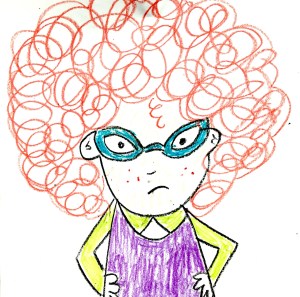
Our first task was fairly simple: draw a self-portrait in “portrait mode.” I began immediately, drawing my typical doodle: huge hair, hands on hips, not-smiley, almost defiant “hmph” face, big glasses. I heard my professor comment from across the table, “No fair. Jen has practice doing this.”

hmph
Yup, that’s me.

We shared our drawings as a way to introduce ourselves, and gave our reasons for attending this workshop. Some of us were getting older and wanted a way to start thinking about their end-of-life decisions, a few were healthcare practitioners, and others were children of aging parents. More than one of us identified as “Graphic Medicine groupies.” One gentleman said he wanted to be more “easy with himself and others” as he aged. Another participant was a self-described “aspiring minimalist,” who was hoping to pare down belongings as she aged.

Most adults do not draw on a regular basis. MK asked us to speculate why this is. We spoke for a moment about the power of crayons: they remind us of a time when we were less inhibited, when we were encouraged to be creative with little expectation or judgment. No matter how old we may be, we can all stand to benefit from “kid thinking.”

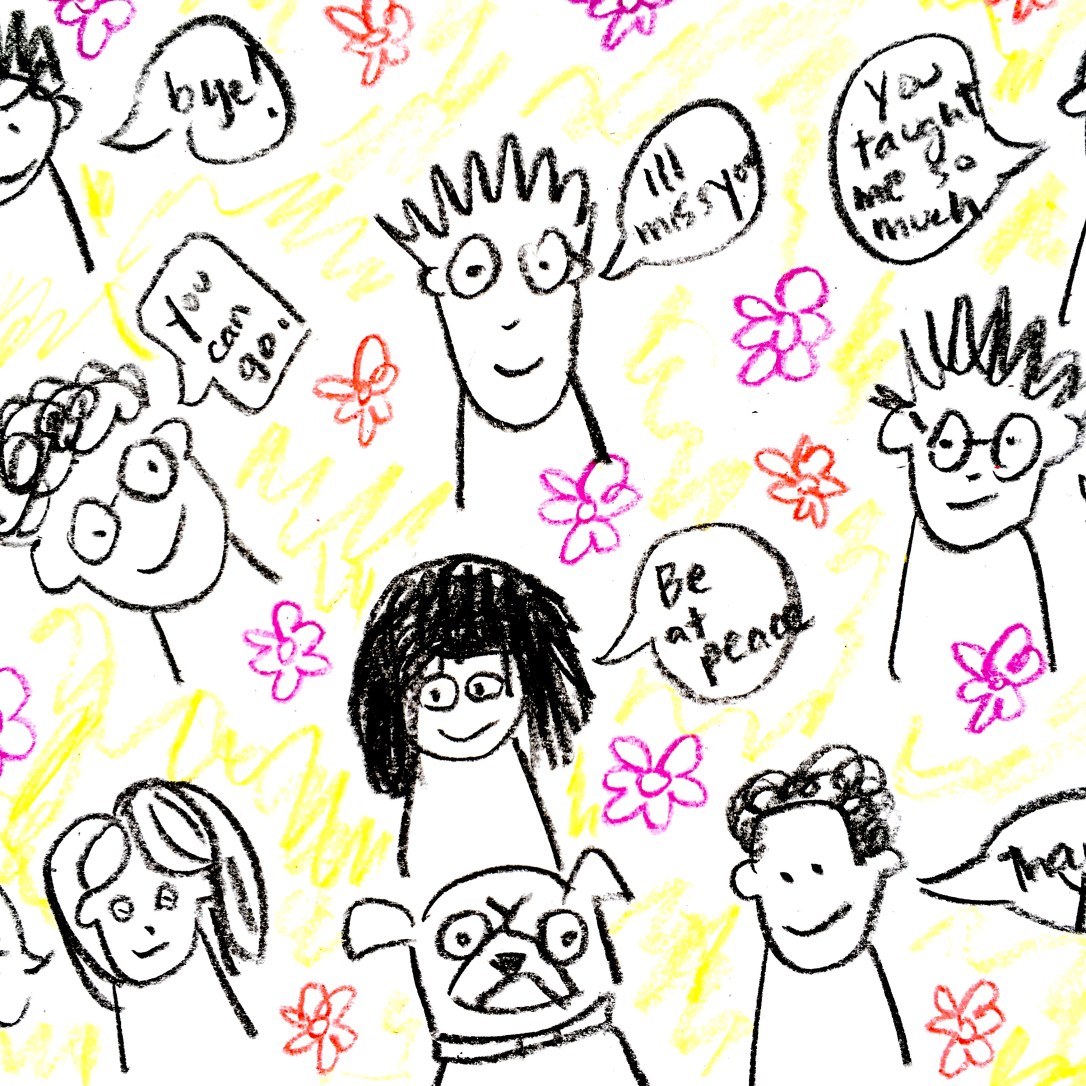
Our next assignment was to hold the paper “landscape style” and draw a good death. We had seven minutes. People got to work immediately, and when it was time to share, many of us were still adding finishing touches. One drawing depicted a series of faces in rainbow shades connected by a line indicating our shared humanity and the cycle of life. Others featured scenes involving nature and blue skies and family and friends. One woman shared her process: her first priority was eating as much chocolate as possible, and only when this was in place did she add lower-priority elements like family and friends (you gotta love that honesty). My drawing was a series of faces in black crayon with speech bubbles. The voices were saying things like, “You can go now. I love you.”

As we were sharing, MK asked us about particular decisions that we made in our work. She spoke to us as if we were legitimate artists sharing our work in a gallery, with comments like “You’re the artist. You make all the choices” and “You are in charge of what this means.” Many of us felt like these alleged decisions were more a function of our limitations rather than our aesthetic acumen. MK offered us a challenge to nourish our artistic selves: draw a self-portrait each day.

So what does one drawing about the end of life have to do with advanced directives? An illustration like this could be a starting point for a conversation about our end-of-life priorities, and MK offered some extensions of this. One was to make our “good death” drawing the center panel of a three-panel comic. What comes before? What comes after? Another prompt would be to draw (then describe) the ideal decision-maker, listing the qualities that would make someone a good healthcare proxy.

It was really incredible to see that a bunch of strangers, each with a box of crayons, could connect so deeply in such a brief period of time. I hate to admit it, but this only child might not have been so nice if she had been forced to share.

Hmph.

chronic illness, My story

Refills are never free

psychdocSo, who prescribed your medicines in 1994?
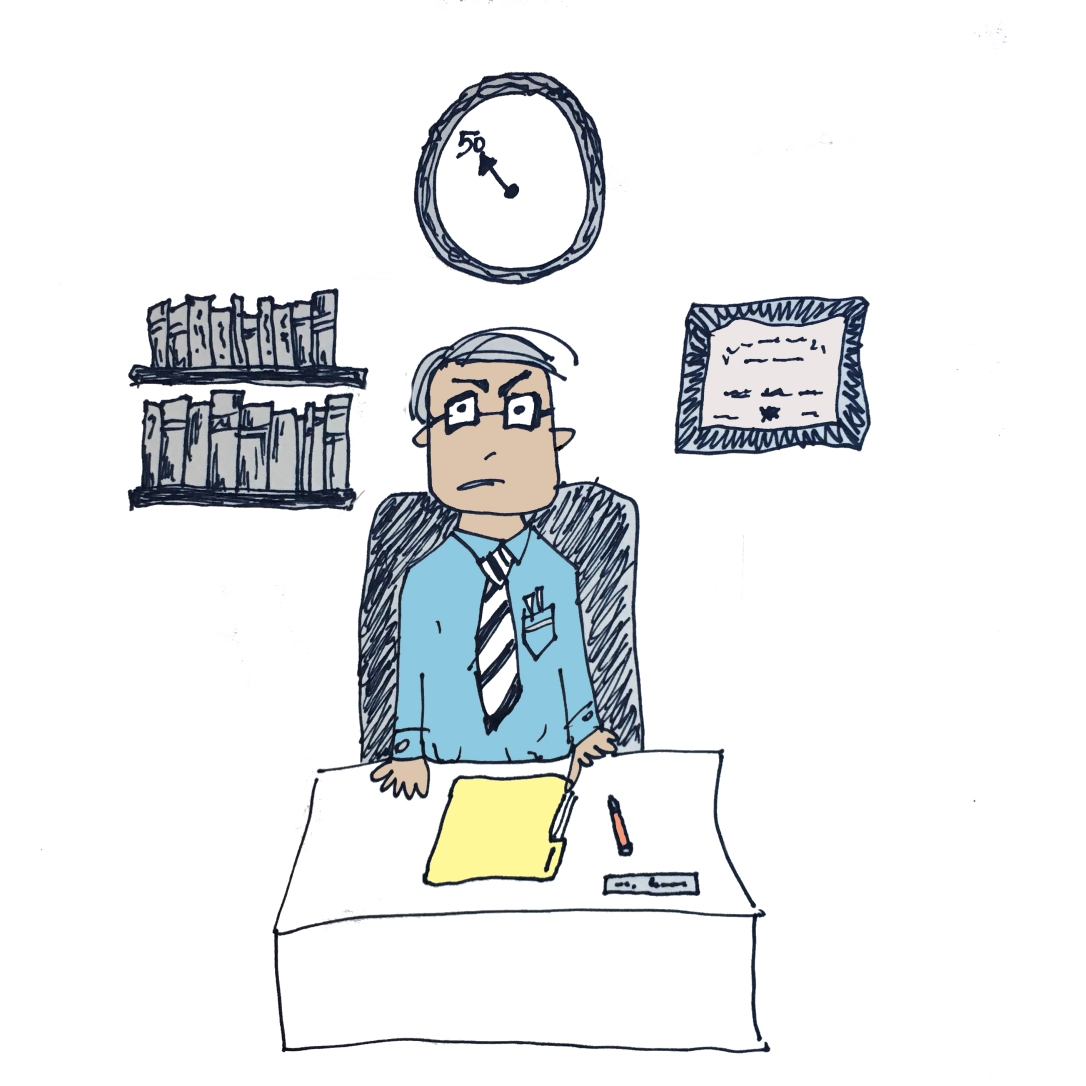
This comes from the new MD who takes my insurance. He pecks away at his keyboard, periodically peering over his laptop’s lid. I ask, “Wasn’t this information in the online intake forms I sent last week?” But what I also want to ask is, “Why does it even matter? The guy was old then. He’s probably dead by now.” Why is this detail even relevant, 24 years later? He continues with his data entry.

And what exactly is Narrative Medicine?

I love when doctors ask this question, especially the ones who can’t seem to maintain eye contact.

Since I started taking classes in Columbia’s MS Program in Narrative Medicine, I have had to answer this question hundreds of times. How I respond usually depends on who is asking. I usually say, “It’s a relatively new discipline that uses the tools of literary analysis to improve the quality of patient care.”

If the other person’s eyes haven’t completely glazed over at that point, I might continue with its origin story: Dr. Rita Charon, then an internist working in a community clinic, felt frustrated with the impersonal nature of the traditional patient encounter. She approached Columbia’s English department to learn how to better attend to and understand the stories of her patients. She stuck around (earning a PhD in the process) and learned to begin her appointments with an open-ended query like “What do you think I should know about you?” She would write and review her clinical notes with her patients, offering them the opportunity to revise the narrative to correct errors or insert omitted details. Considering that the average physician can only last 11 seconds into a visit before interrupting a patient, this approach was revolutionary.

But when a new doctor asks me about Narrative Medicine, I feel like my answer is a challenge: I study how doctors should treat patients. I believe that the story of embodied experience, told by the person living with illness, is more important than the forms on your computer. In other words: watch it; this woman is taking notes. Look up from your screen long enough to see me.

I anticipate his next question: What does this have to do with you? You’re not a doctor. Yes, but I am a person with a body and I am tired of being interrupted after 11 seconds. I am also a recovering high school English teacher, so it makes sense that I would be drawn to literature, philosophy, anthropology, sociology, and the narratives of patients, clinicians, and caregivers. In addition to reading, we look at paintings. We listen to spoken word poetry. We slow down, and we examine everything.

My response causes a subtle but palpable shift in the power dynamic in the room, and I feel like I am in that episode of Portlandia where two friends show off by book-shaming and one-upping each other: (Did you read this? Did you read that? Did you read the article in the New Yorker? Did you read the editorial in the New York Times? Did you read the classifieds? Did you read the menu?). He quizzes me on my knowledge of psychiatry, and I pass. I get the feeling he’s going to be looking up a few books after I leave.

When should my therapist call you? I ask.

Anytime, day or night. I begin to think he’s really dedicated. Until he ruins it: All times are equally bad.

Though this doctor is far from perfect, he’s a huge improvement over the last one I tried, so I’ll keep him (at least for now) to keep my refills coming.

chronic illness

Being unremarkable

handtaco.jpg
The cat stays in the picture.

I’ve been spending a lot of time thinking about my hands lately. Until now, my latest problem was some kind of muscular problem at the base of my thumb that doesn’t fit any singular diagnosis. After three more months of weekly occupational therapy and twenty minutes a day of hand, finger, and wrist-strengthening exercises, I can go for longer periods using my hands without pain. This is definitely progress. I also don’t type all day anymore, which definitely helps.

Now I have a new ailment to add to my keychain of pain: a knobby swelling of the knuckle on the middle finger on my left hand which feels a lot like osteoarthritis. According to the  radiologist’s report, my X-rays are “unremarkable.” Not even worth talking about. Hmph. All I know is that I wake up every morning feeling swollen and looking freakishly inflamed, like I have a bunion on my finger. Could it still be arthritis, but just not show up on the x-ray? I feel like all of the problems I’ve had with my hands and arms have been this way: not-quite carpal tunnel, not-quite tendinitis, not-quite pinched nerves. Not-quite legitimate.  

I have become quite the complainer.

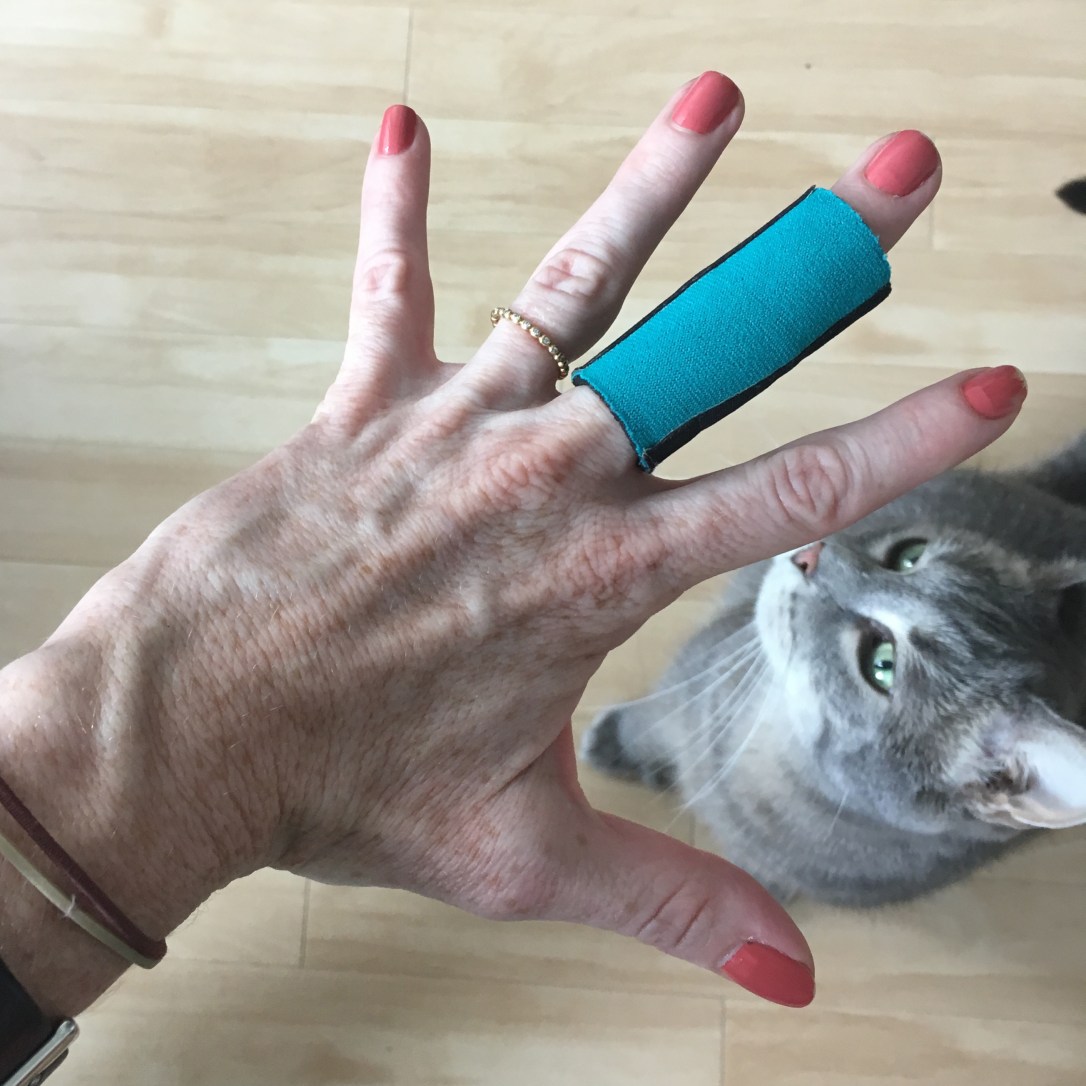
Regardless of the (lack of) diagnosis, we still have to treat the symptoms. In the world of OT, that means more splints. I got a turquoise neoprene finger sleeve to wear at night (I imagine a factory somewhere where workers decapitate gloves, sending the resulting fingerless remnants to weightlifters). When my pain didn’t subside, she made a(nother) custom splint ($230 billed to Blue Cross), shaped like an old 110-film canister, that imprisons my middle finger between its two adjacent fingers. This is supposed to keep me from overextending it. Instead, it mainly restricts my ability to use my left hand and cuts off the circulation to my pointer finger.

My problem, they all say, is that I’m hypermobile. Allegedly my joints are very flexible and I can hold myself in unhealthy postures to compensate for muscle weakness and bad posture, even in my hands. Giving me a splint usually means that my body will just create a workaround that will do even more damage. And so, the cycle continues.

It’s kind of funny that my body is set up to unwittingly sabotage my progress. Every time I go to the OT “gym” (where the hardest exercises include picking pennies hidden in of a huge blob of putty), I feel like I am being reprimanded for my hyperflexibility. There’s probably a metaphor in there somewhere. Am I bending to meet everyone else’s needs, instead of making myself stronger?

Hmph.