
As one of my coach credentialing requirements, I must complete a series of “mentor coach” sessions with the founder of my training program. I just finished my third such session with S a few hours ago and I am still thinking about it, or, should I say, feeling it. We have been looking at the International Coach Federation (ICF)’s Core Competencies, which include skills such as active listening and powerful questioning. For the first two sessions, we focused on these competencies in the context of my work with a client.
The way a typical coaching session is structured is, after the initial pleasantries are over, the conversation shifts to an update about progress made since the last session. The “coachee” talks about what she’d like to work on in general, and then we narrow the focus to what could be accomplished during that particular session. I noted that I had been feeling “stuck” in building my coaching website, and, in effect, launching me-as-coach into the larger world. Instead of speaking about my client, S allowed us to deviate from the script.
My trouble still remains in deciding how much myself to include in my professional website. I am trying to create an online presence that feels
- authentic (represents who I am as accurately as possible, and connects with my intended audience)
- cohesive (tells a story that honors my varied identities as an artist, a writer, a teacher, a scholar, and patient-advocate/peer)
- authoritative (conveys the fact that I am uniquely qualified for my particular niche)
- engaging (inspires people to want to work with me; is not rigid or stuffy)
For the past two weeks, I have been sucke(re)d into a self-inflicted vulnerability vortex with this question: how much of my personal struggles do I share in order to explain my passion for this particular work, but not to undermine my credibility as a professional?
S sensed that this issue was holding me back and asked which of the ICF competencies we might use as the focus of our call to address it.
I immediately came to Establishing Trust and Intimacy with the Client, which, at the Master coach level, entails (emphasis mine):
- Coach is willing to be vulnerable with client and have client be vulnerable with
Coach. - Coach confident in self, process, and the client as a full partner in the relationship.
- Sense of complete ease and naturalness in conversation; coach does not have to “work” to coach.
Although we usually role-play with S as client and me as coach, S proposed that we explore my “stuck-ness” in a mini coaching session, and debrief about it afterward. She asked if we could record our call so I could reflect on it later, and, with my permission, she could use it with future students. I immediately agreed.
After I floundered for a bit explaining the root of my problem (which was a combination of being “confident in self” with a sense of “complete ease”), S asked how it would feel to spend an hour working on my site and then just publish it (this how would it feel question, in coach-speak, is called visioning). Of course that would feel great. How would I like to move that forward? I could update my site immediately after our call, for starters. Knowing that I often operate in overthinking mode, S asked what else I might do to embody that sense of ease and confidence. What might that look like?
Wait. What?
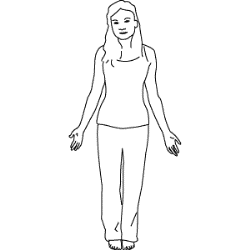
Damn. Embodiment. That’s it! Embodiment goes beyond thinking or feeling or talking or doing. It is simply being, taking up space that has a shape. Thinking, feeling, talking, and doing are occur in and through the body. So what would the embodiment of ease look like? I immediately went to yoga: Tadasana, or mountain pose, standing tall with arms at sides, palms facing out. It is not an aggressive—or even assertive—power pose; it is simply a grounded, open one.
So after I exhausted myself with rationalizations, I went back to my body.
Tadasana.

 this gruntled worker