chronic illness, My story

Refills are never free

psychdocSo, who prescribed your medicines in 1994?

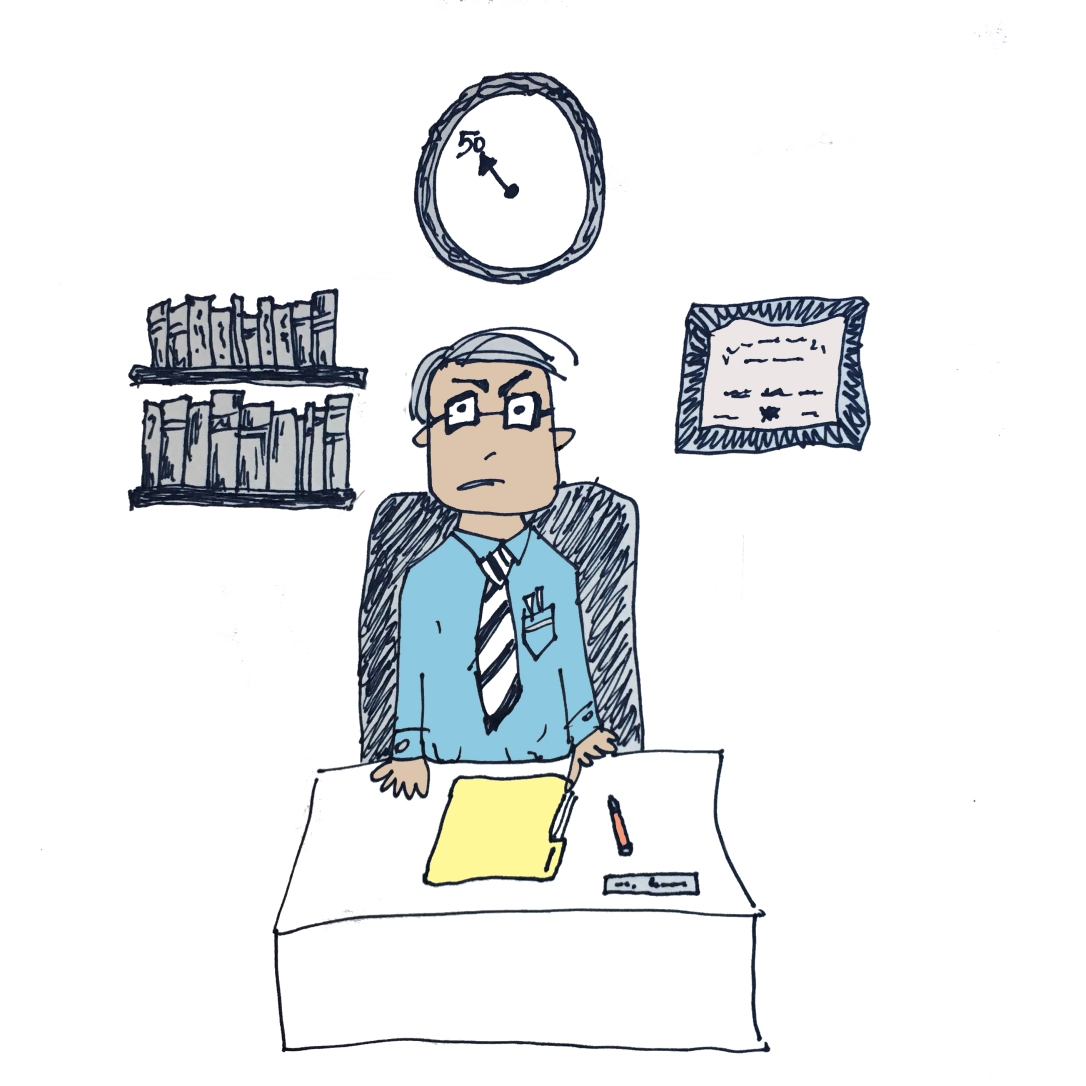
This comes from the new MD who takes my insurance. He pecks away at his keyboard, periodically peering over his laptop’s lid. I ask, “Wasn’t this information in the online intake forms I sent last week?” But what I also want to ask is, “Why does it even matter? The guy was old then. He’s probably dead by now.” Why is this detail even relevant, 24 years later? He continues with his data entry.

And what exactly is Narrative Medicine?

I love when doctors ask this question, especially the ones who can’t seem to maintain eye contact.

Since I started taking classes in Columbia’s MS Program in Narrative Medicine, I have had to answer this question hundreds of times. How I respond usually depends on who is asking. I usually say, “It’s a relatively new discipline that uses the tools of literary analysis to improve the quality of patient care.”

If the other person’s eyes haven’t completely glazed over at that point, I might continue with its origin story: Dr. Rita Charon, then an internist working in a community clinic, felt frustrated with the impersonal nature of the traditional patient encounter. She approached Columbia’s English department to learn how to better attend to and understand the stories of her patients. She stuck around (earning a PhD in the process) and learned to begin her appointments with an open-ended query like “What do you think I should know about you?” She would write and review her clinical notes with her patients, offering them the opportunity to revise the narrative to correct errors or insert omitted details. Considering that the average physician can only last 11 seconds into a visit before interrupting a patient, this approach was revolutionary.

But when a new doctor asks me about Narrative Medicine, I feel like my answer is a challenge: I study how doctors should treat patients. I believe that the story of embodied experience, told by the person living with illness, is more important than the forms on your computer. In other words: watch it; this woman is taking notes. Look up from your screen long enough to see me.

I anticipate his next question: What does this have to do with you? You’re not a doctor. Yes, but I am a person with a body and I am tired of being interrupted after 11 seconds. I am also a recovering high school English teacher, so it makes sense that I would be drawn to literature, philosophy, anthropology, sociology, and the narratives of patients, clinicians, and caregivers. In addition to reading, we look at paintings. We listen to spoken word poetry. We slow down, and we examine everything.

My response causes a subtle but palpable shift in the power dynamic in the room, and I feel like I am in that episode of Portlandia where two friends show off by book-shaming and one-upping each other: (Did you read this? Did you read that? Did you read the article in the New Yorker? Did you read the editorial in the New York Times? Did you read the classifieds? Did you read the menu?). He quizzes me on my knowledge of psychiatry, and I pass. I get the feeling he’s going to be looking up a few books after I leave.

When should my therapist call you? I ask.

Anytime, day or night. I begin to think he’s really dedicated. Until he ruins it: All times are equally bad.

Though this doctor is far from perfect, he’s a huge improvement over the last one I tried, so I’ll keep him (at least for now) to keep my refills coming.
My story

Here’s my story.

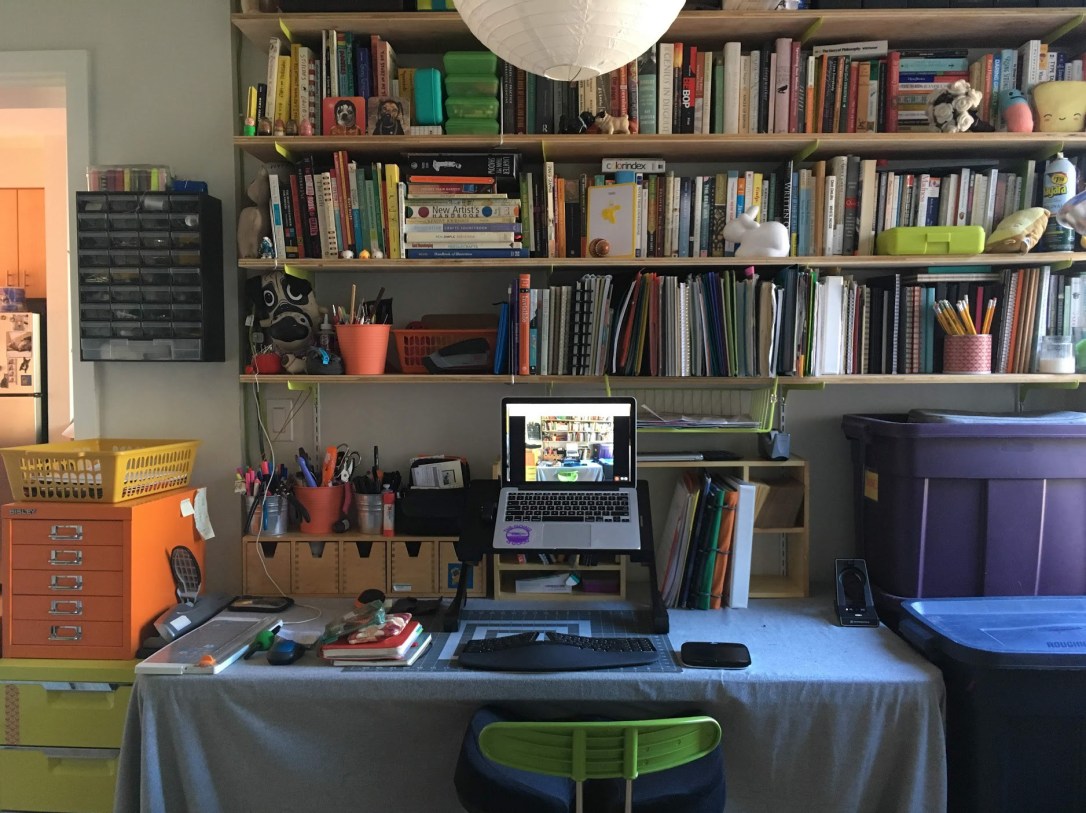
desk-new-2For years, I was perfectly fine with the double life of an office-worker-by-day and artist and student by night. When my hands, wrists, neck and back all went on strike and I lost my ability to type, to write, or to draw, I felt completely useless. I was in constant pain and I blamed myself for not getting better. Maybe this was more than just a physical issue, I wondered. Is it work itself that’s making me unhappy? After a year of deliberation, I made a radical change.
I quit my job.

That’s right. I ended up becoming so obsessed with the idea of sustainable, meaningful work that I actually left my job to study it. As my body began to heal, I asked other women about their work lives, and heard stories of otherwise high-achieving women who were happy enough, but who had this other thing that they really wanted to do. In some cases, it was a creative side project; in others, it was a complete career overhaul. I suddenly realized: these are the people I need to serve.

Keep scrolling to hear about my process.

Advocacy, My story

How to be your own patient advocate

dating-2Orthopedists, I’ve had a few. Three, to be precise. I feel like I’m playing The Dating Game. Hopefully, (bachelor-)doctor number three will be a keeper and not a polyester-leisure-suit wearing dud. If you’re just tuning in, allow me to give you a recap:

Doctor Number One works in a university medical center clinic. He sent me for a nerve conduction study administered by a resident who botched it, zapping me repeatedly on each contact point in order to get an accurate reading. The report indicated an “abnormal but incomplete study” because “patient complained and test was stopped” rather than “resident didn’t know how to administer the test and patient was tired of electric shocks.” Inconclusive. If we inject your wrist with steroids and you feel better, my doctor later concluded, you have carpal tunnel. Instead, I mostly felt weepy. The pain traveled from my thumb to my wrist to my forearm to my neck and back, only intermittently responding to treatment. Unhappy with my results and unwilling to wait two months to schedule a follow-up appointment, I went elsewhere.

Doctor Number Two is in private practice (pros: much nicer office; no wait time). When my symptoms didn’t respond quickly enough to another round of physical therapy, he suggested that I get an epidural in my spine. Only when I expressed concern about the possible hormonal side effects did he share his own experience. Laughing, he explained that his shot had made him so irritable that he fired one of his employees and so wired that he planted a giant raspberry patch in his backyard at 3am. But his back didn’t hurt, so it was worth it. Here’s the thing: I didn’t want to just alleviate my pain, which was now only in my thumb and forefinger. I wanted to fix the cause of it. I also had no interest in becoming a nocturnal raspberry farmer.

When it comes to chronic pain (in my case, for a diagnosis-defying repetitive stress injury), it’s easy to feel like you’re constantly complaining. That’s because it constantly hurts. My hands and arms were useless for writing, working, and sewing, my three main activities. Through this process, I have learned a little bit about self-advocacy.

Like the ladies on The Dating Game, I was optimistic about my third option, a doctor at yet another teaching hospital. Tired of answering the same questions and of not getting any relief, I decided to take charge of the situation. Here’s what I learned:

  1. Create a BRIEF timeline of symptoms, doctor’s visits, treatments, and results. There is no way I could have remembered all of these details, so I wrote them down. Doctors are scientists; they like numbers: how intense was the pain on a scale of 1 to 10? How many days did it last? What helped it improve? Just the bullet points. You can fill in the  rest later.
  2. Get copies of your medical records, including test results, and bring an extra copy to your visit. I never trust a doctor’s office to fax a copy of my records to another doctor. Do you see how busy that reception desk always is?
  3. Let them know what treatment has worked and what hasn’t. This includes writing down the names, doses, and side effects of your medicines or other interventions. I know that in order for me to get another steroid injection, I would have to exhaust all other options. I’m not there yet.
  4. Speak up. If your provider seems to be ignoring a particular symptom because it doesn’t fit a particular diagnostic profile, say something. For me, the weird muscular pain in my thumbs was not the result of nerve damage or tendinitis, but it was still very real.

So how did it go with Doctor Number Three? I began by asking if I could give my summary before he started asking questions. Like an attorney submitting evidence to the court, I handed over copies of my MRI, nerve conduction tests, and X-rays, with a flourish. He listened intently.

After about five minutes (which is all I needed), we went through a series of Simon Says commands. Does it hurt when you do this? Does it hurt when you do this? It never does. A few more questions and physical challenges, and now he, too was bewildered. Why do my thumb and forefinger hurt when I have no sign of nerve damage, carpal tunnel, or tendonitis? I started to doubt myself and question my reliability as a narrator of my symptoms.

To his credit, this guy did not seem frustrated with me for not fitting into one of his neat diagnostic categories; he was clearly up for the challenge. I finally said, in exasperation, look, it feels like it’s muscular pain in my thumb and forefinger. When I press here, I say, indicating the meaty part of the base of my thumb, it hurts. Same thing on the outside of my wrist – not sharp pain, not tingling pain, but dull muscular aching. I can’t use my hands for more than five minutes, and I can’t live this way.

I know I am (a bit of) an annoying patient: I refuse to settle for managing pain without understanding its cause. He understood that I certainly didn’t want an injection or painkillers, and offered a compromise: a glorious topical cream and a bunch of occupational therapy for my thumb joint. The only diagnosis we have settled on is that it is a repetitive stress injury. But, unlike the other two doctors who were too over scheduled, too frazzled, or too eager to medicate me, bachelor/doctor number three heard me out, so he just might be a keeper.

Our second date is next week. Wish me luck.

My story, Support System

Five simple questions

where-going.pngI learned today that my greatest strength is that I keep going like the Energizer Bunny, and that my greatest weakness is that I overthink things. I learned these things by asking a few questions to the right people.

Last week, while I was hoofing it on the elliptical at the gym, I was listening to one of my favorite podcasts: How to Be Awesome at your Job. The host, Pete Mockaitis, was interviewing Maxie McCoy, women’s leadership speaker and author of You’re Not Lost: an Inspired Action Plan for Finding Your Own Way. Through speaking with hundreds of women, McCoy heard several recurring questions: “Am I doing the right things? Is what I’m feeling normal? How do I handle this doubt? Where the heck am I going with my life?” She wants to reassure us:

You don’t have to know where you’re going in order to begin … we can find our way when we tap into a really deep sense of self-belief in order to take small step after small step after small step.

So how do we figure out which steps to take? McCoy says the first questions to ask are “What energizes you?” and “Where have you felt the most proud, energized, and connected to power?” Once you answer these questions, she wants you to ask yourself why. Do this three times. Then, she says, start taking steps to create action, no matter how insignificant the action may seem.

Back when I was feeling a little uninspired at work, I would come home and crochet for hours. What is it about crochet that brings me joy? Memories of sitting next to my grandmother, who would remind me not to make my stitches too tight. Expressing my creativity. Making things that would provide warmth and comfort to others. The next question to ask would be: what actions could I take to get more of that feeling in my life? By gravitating toward these I would be paving my own path as I’m traveling along it. Baby steps.

At the end of the episode, McCoy mentions a fabulous exercise that you can try to identify where you have the most energy (added bonus: you’ll get a boost if you’re feeling a bit lost): surveying people in your support system.

Here are the questions that she uses:

  1. Why am I irreplaceable?
  2. What is my superpower?
  3. What is holding me back?
  4. Where will I be in five years?
  5. What are my talents, potential, and unique value?

McCoy had one friend collect and tabulate these responses, and present them in person (without attribution) to her. When I tried this, I switched it up a little bit, emailing a handful of friends and family who know me well. Because I knew this exercise would take some time, I thought it would only be fair if I reciprocated. If we keep going, we’ll create a veritable Amway pyramid scheme of empowerment! What resulted for me were some really insightful conversations and some very genuine expressions of gratitude.

Give it a try. This Energizer Bunny thinks you should.