
coaching, Support System

Compassionate Rabbits

rabbit.jpg

Everyone seems to be talking about curious compassion lately.  I saw it in Brene Brown’s new book, Dare to Lead, and in Michael Bungay Stanier’s book, The Coaching Habit, and even heard on the How to Be Awesome at your Job podcast while I was at the gym this week. When I heard the phrase a fourth time in class this afternoon, I knew something was definitely up.

So what is curious compassion, anyway?

It means listening to someone else’s story and withholding judgment—not waiting for your turn to speak, but just holding a space for the other person to feel whatever it is they’re feeling. The next part is even harder: approaching any response or reaction from a place of curiosity rather than one of judgment. In the case of a friend who is stressed out or upset, this might mean asking, “what would support from me look like?” This is much better than the half-assed, “Let me know if you need anything” or any unsolicited advice.

Let me give you an example. Recently, a colleague was stressed about marketing materials for an event that was due to happen in a few weeks. There were multiple layers of approvals that needed to happen before we could post our flyer, and she was really worried that we wouldn’t have it out in time to get a good turnout for the event. When she voiced this concern, my attempt to reassure her came out as, “Don’t worry – we have plenty of time. It’ll be fine.” Then I caught myself. I apologized, recognizing that my response was pretty invalidating. I was, in effect, telling her that she didn’t have the right to feel as she did. And when is the last time the phrase “don’t worry” worked for anyone? Exactly. My next attempt was not much better: I said, “I know how you feel; I get anxious too.” But I don’t know exactly how she feels. Damnit; this is hard!

This reminds me—I read another good book this week, a children’s picture book called The Rabbit Listened by Cori Doerrfeld. It teaches kids empathy and non-judgment. Taylor, a little boy dressed in striped pajamas, is building an elaborate structure with his blocks and it tumbles down. He is inconsolable. A parade of zoo animals pays their respects, offering suggestions or advice like “Get mad!” Or “Go for a walk!” Not to be a spoiler, but you know the Rabbit is going to have a different approach. He just sits silently with Taylor in his distress, and the boy feels safe to explore his feelings and share his frustrations. By the end, he begins to play with his blocks again.

Curious compassion would be just listening without the urge to problem solve or jump in with my opinion. It is holding space for the other person to express themselves fully without fear of being bulldozed with my damn opinions. We have to get out of the framework of quick-fix solutions. It’s much easier easier to make our own discomfort go away than to sit with a friend who is experiencing it.

So let’s all channel our inner rabbits…
 

Productivity, Support System, Work tools

How to be your story’s protagonist

levelupImagine creating a secret identity for yourself, and now you are strong and brave and unafraid. You are resourceful, ready to vanquish enemies. You are part of a worldwide tribe that energizes and supports you. You are doing things you never thought possible and feel exhilarated and challenged. You are mastering—not enduring—life!  Sounds pretty good, right?

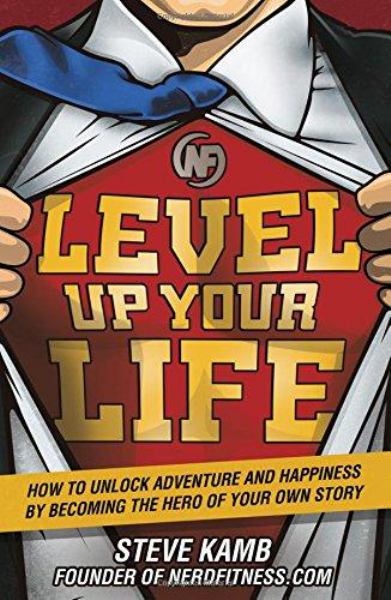
A few weeks ago, I was browsing the shelves at the public library and found Steve Kamb’s 2016 book Level Up your Life. The subtitle reads: How to Unlock Adventure and Happiness by Becoming the Hero of your Own Story.  A book combining narrative and agency to help people reach their goals? He has my attention.

The cover depicts a comic book-style illustration of a man ripping off his business shirt and tie to reveal his (six-pack abs and his) superhero costume. Our hero is answering a call to action; someone, somewhere, is in distress. Kamb does not need to rescue us readers, however. He offers an adaptable blueprint so that we can save ourselves. With a little imagination and discipline, even the humblest of nerdy office drones can take charge of her life, break free from being ordinary, and join this Rebellion. And she can have a lot of fun while doing so.

Kamb, the founder of nerdfitness.com, is a self-proclaimed formerly “risk-averse, picky eating introvert who felt more at home in front of a computer than in public.” He was happy enough in his post-college job, but was vaguely dissatisfied. After moving cross-country for a more interesting, but lower-paying job, he realized that he was still wasting his evenings and weekends drinking and playing video games to numb himself from his uninspiring life. He wanted a challenge, so he began with getting fit.

Kamb recontextualized his fitness quest as a game: he developed an origin story, an alter ego identity, and a series of increasingly more difficult challenges (in video games, this is known as leveling up). Once he began to see actual results from his workouts, he decided to help other nerds do the same by using game theory. He put his own video games aside, and for the next 18 months, devoted that same energy to building an online community. Then, he applied his method to other areas of his life. He knew he was onto something.

What I love about this book is that it is not just one guy bragging about how cool his life is now, how he is traveled to blah blah countries and done blah blah cool things. He makes leveling up accessible, encouraging his readers to start small while challenging them to play on increasingly difficult levels. Because he is a nerd, Kamb sprinkles references to video games and fantasy and science fiction characters throughout the book. He also builds his hero’s journey on the work done by Joseph Campbell and Christopher Vogler. Each step has its own chapter.

The main character is somebody of normal existence who goes through a journey that fundamentally changes him or her as a character. This character learns from a mentor, skeptically accepts the call to leave a comfortable existence, faces trials and tribulations, makes allies and enemies, outsmart or wins over the guardians of the threshold, struggles to survive/succeed, transforms, and ultimately returns home with altered/improved outlook on life.

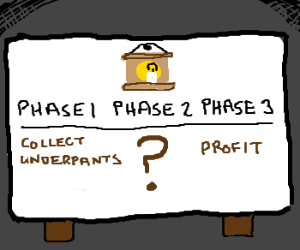
My biggest takeaway from this book is the cautionary tale of the South Park Underpants Gnomes. In the middle of the night, these little elves run around the fictional cartoon town, stealing people’s underpants. When asked why they are doing this, one replies, “Collecting underpants is just Phase 1!” When asked about Phase 2, the gnomes reply with, “Phase 3 is profit!” The gnomes never find out what Phase 2 is. Kamb’s message to his readers: stop mindlessly collecting underpants, or don’t consume yourself with busy work that doesn’t move you toward your goal. You have to  take action in Phase 2, or you will just have a shit-ton of underpants and no profit.

gnomes
Underpants Gnomes from South Park

This idea really hit home for me as I think back to my summer research project. In the beginning, I was obsessed with collecting all available information on my topic. I became a hoarder of articles and blog posts and books, and wasted hours organizing them into an indexed binder. I knew my goal was to write a paper, so why was I wasting my time? At one point, my advisor had to cut me off. She said, “That’s it! No new sources!”

gnome plan
You gotta have a Phase 2.

Damnit,  I thought.  Now I am going to have to do some real work.

Even if you don’t pick up the book, I hope you have learned this from Kamb, from the makers of South Park, and from me: Don’t be an Underpants Gnome.

My story, Support System

Five simple questions

where-going.pngI learned today that my greatest strength is that I keep going like the Energizer Bunny, and that my greatest weakness is that I overthink things. I learned these things by asking a few questions to the right people.

Last week, while I was hoofing it on the elliptical at the gym, I was listening to one of my favorite podcasts: How to Be Awesome at your Job. The host, Pete Mockaitis, was interviewing Maxie McCoy, women’s leadership speaker and author of You’re Not Lost: an Inspired Action Plan for Finding Your Own Way. Through speaking with hundreds of women, McCoy heard several recurring questions: “Am I doing the right things? Is what I’m feeling normal? How do I handle this doubt? Where the heck am I going with my life?” She wants to reassure us:

You don’t have to know where you’re going in order to begin … we can find our way when we tap into a really deep sense of self-belief in order to take small step after small step after small step.

So how do we figure out which steps to take? McCoy says the first questions to ask are “What energizes you?” and “Where have you felt the most proud, energized, and connected to power?” Once you answer these questions, she wants you to ask yourself why. Do this three times. Then, she says, start taking steps to create action, no matter how insignificant the action may seem.

Back when I was feeling a little uninspired at work, I would come home and crochet for hours. What is it about crochet that brings me joy? Memories of sitting next to my grandmother, who would remind me not to make my stitches too tight. Expressing my creativity. Making things that would provide warmth and comfort to others. The next question to ask would be: what actions could I take to get more of that feeling in my life? By gravitating toward these I would be paving my own path as I’m traveling along it. Baby steps.

At the end of the episode, McCoy mentions a fabulous exercise that you can try to identify where you have the most energy (added bonus: you’ll get a boost if you’re feeling a bit lost): surveying people in your support system.

Here are the questions that she uses:

  1. Why am I irreplaceable?
  2. What is my superpower?
  3. What is holding me back?
  4. Where will I be in five years?
  5. What are my talents, potential, and unique value?

McCoy had one friend collect and tabulate these responses, and present them in person (without attribution) to her. When I tried this, I switched it up a little bit, emailing a handful of friends and family who know me well. Because I knew this exercise would take some time, I thought it would only be fair if I reciprocated. If we keep going, we’ll create a veritable Amway pyramid scheme of empowerment! What resulted for me were some really insightful conversations and some very genuine expressions of gratitude.

Give it a try. This Energizer Bunny thinks you should.

Support System

Accountabili-bitches

median
Where great ideas are born.

The other day, with a few minutes to spare before I had to go back uptown, my blogger friend Anita and I were sitting on a bench between the uptown and downtown traffic on Broadway at 86th Street. I would often pass these random benches and think, “who the hell would want to relax in the middle of Broadway?” I had my answer–two friends with ten minutes to kill while drinking iced tea. Once again, we were wistfully cataloguing the projects we wanted to finish and berating ourselves for our lack of focus and discipline.

Back when we both worked in Midtown, Anita and I used to catch up over a scone at Amy’s Bread each Friday. I suggested we reinstate this ritual. I thought, beyond just catching up, we could ask each other the question, “What are you going to get done for next week?” But, because Anita and I are ruthlessly honest with each other (she’s the best person to take shopping), I slanged it up: “What are you gonna do for next week, BITCH?” Then I thought about the other women in my life, who, after the obligations of work and family, rarely have enough time to devote to their own personal projects. What if we all got together (in person or online) for a weekly check-in? I was beginning to like this accountability buddy idea. Accountabilibitches!

What are you going to do for next week is not a resolution–it is setting an intention for action. Next week is less daunting then a nebulous “soon” or an impossible “next year” resolution. Next week is doable. In one week, I could go to the gym twice. I could write one blog post. I could cook one dinner from scratch. I could read one book. I could watch one tutorial on YouTube. With a little help from my friends, I think I could keep a promise to my next week’s self.

Even my mom loves this idea. To soften the edges of its name, I suggested she call her group accountabilibiddies.

What are YOU gonna do for next week?