coaching, My story

The Embodiment of Ease

mountain
source: Kripalu Yoga

As one of my coach credentialing requirements, I must complete a series of “mentor coach” sessions with the founder of my training program. I just finished my third such session with S a few hours ago and I am still thinking about it, or, should I say, feeling it. We have been looking at the International Coach Federation (ICF)’s Core Competencies, which include skills such as active listening and powerful questioning. For the first two sessions, we focused on these competencies in the context of my work with a client.

The way a typical coaching session is structured is, after the initial pleasantries are over, the conversation shifts to an update about progress made since the last session. The “coachee” talks about what she’d like to work on in general, and then we narrow the focus to what could be accomplished during that particular session. I noted that I had been feeling “stuck” in building my coaching website, and, in effect, launching me-as-coach into the larger world. Instead of speaking about my client, S allowed us to deviate from the script.

My trouble still remains in deciding how much myself to include in my professional website. I am trying to create an online presence that feels

  1. authentic (represents who I am as accurately as possible, and connects with my intended audience)
  2. cohesive (tells a story that honors my varied identities as an artist, a writer, a teacher, a scholar, and patient-advocate/peer)
  3. authoritative (conveys the fact that I am uniquely qualified for my particular niche)
  4. engaging (inspires people to want to work with me; is not rigid or stuffy)

For the past two weeks, I have been sucke(re)d into a self-inflicted vulnerability vortex with this question: how much of my personal struggles do I share in order to explain my passion for this particular work, but not to undermine my credibility as a professional?

S sensed that this issue was holding me back and asked which of the ICF competencies we might use as the focus of our call to address it.

I immediately came to Establishing Trust and Intimacy with the Client, which, at the Master coach level, entails (emphasis mine):

  • Coach is willing to be vulnerable with client and have client be vulnerable with
    Coach.
  • Coach confident in self, process, and the client as a full partner in the relationship.
  • Sense of complete ease and naturalness in conversation; coach does not have to “work” to coach.

Although we usually role-play with S as client and me as coach, S proposed that we explore my “stuck-ness” in a mini coaching session, and debrief about it afterward. She asked if we could record our call so I could reflect on it later, and, with my permission, she could use it with future students. I immediately agreed.

After I floundered for a bit explaining the root of my problem (which was a combination of being “confident in self” with a sense of “complete ease”), S asked how it would feel to spend an hour working on my site and then just publish it (this how would it feel question, in coach-speak, is called visioning). Of course that would feel great. How would I like to move that forward? I could update my site immediately after our call, for starters. Knowing that I often operate in overthinking mode, S asked what else I might do to embody that sense of ease and confidence. What might that look like?

Wait. What?

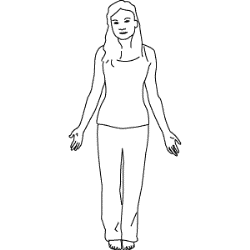
Damn. Embodiment. That’s it! Embodiment goes beyond thinking or feeling or talking or doing. It is simply being, taking up space that has a shape. Thinking, feeling, talking, and doing are occur in and through the body. So what would the embodiment of ease look like? I immediately went to yoga: Tadasana, or mountain pose, standing tall with arms at sides, palms facing out. It is not an aggressive—or even assertive—power pose; it is simply a grounded, open one. 

So after I exhausted myself with rationalizations, I went back to my body.

Tadasana.
 

chronic illness, Graphic Medicine

Death and Crayons

good-death

On Halloween, I attended the Reimagine: End of Life workshop called Graphic Medicine, Reflective Drawing, and Advanced Care Directives at the 53rd Street library. It was led by MK Czerwiec, author of Taking Turns: Stories from HIV/AIDS Care Unit 371. MK is one of the founders of Graphic Medicine, a genre of patient and caregiver narratives in a comics format.

As soon MK began to unpack her supplies, putting a brand new (!) pack of 24 Crayola crayons at each chair, I knew I was in the right place: we were going to draw! My giddiness was echoed in the voices of the other participants. Most of us were middle aged or older, but the moment we opened our boxes and inhaled that signature crayon smell, we were immediately nostalgic. I was transported (way) back to elementary school—that glorious time when I was allowed to call myself an artist.

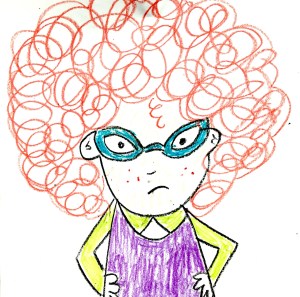
Our first task was fairly simple: draw a self-portrait in “portrait mode.” I began immediately, drawing my typical doodle: huge hair, hands on hips, not-smiley, almost defiant “hmph” face, big glasses. I heard my professor comment from across the table, “No fair. Jen has practice doing this.”

hmph
Yup, that’s me.

We shared our drawings as a way to introduce ourselves, and gave our reasons for attending this workshop. Some of us were getting older and wanted a way to start thinking about their end-of-life decisions, a few were healthcare practitioners, and others were children of aging parents. More than one of us identified as “Graphic Medicine groupies.” One gentleman said he wanted to be more “easy with himself and others” as he aged. Another participant was a self-described “aspiring minimalist,” who was hoping to pare down belongings as she aged.

Most adults do not draw on a regular basis. MK asked us to speculate why this is. We spoke for a moment about the power of crayons: they remind us of a time when we were less inhibited, when we were encouraged to be creative with little expectation or judgment. No matter how old we may be, we can all stand to benefit from “kid thinking.”

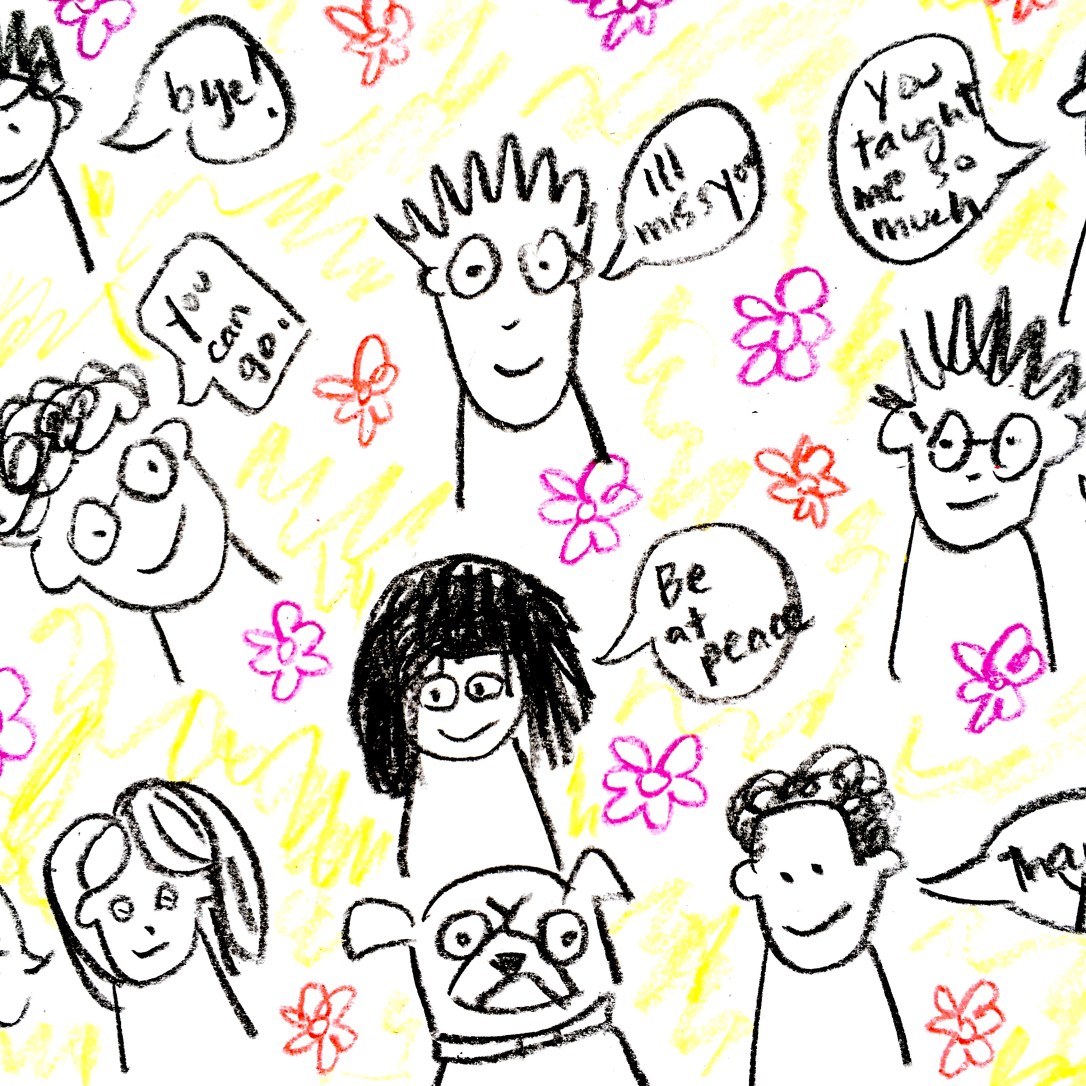
Our next assignment was to hold the paper “landscape style” and draw a good death. We had seven minutes. People got to work immediately, and when it was time to share, many of us were still adding finishing touches. One drawing depicted a series of faces in rainbow shades connected by a line indicating our shared humanity and the cycle of life. Others featured scenes involving nature and blue skies and family and friends. One woman shared her process: her first priority was eating as much chocolate as possible, and only when this was in place did she add lower-priority elements like family and friends (you gotta love that honesty). My drawing was a series of faces in black crayon with speech bubbles. The voices were saying things like, “You can go now. I love you.”

As we were sharing, MK asked us about particular decisions that we made in our work. She spoke to us as if we were legitimate artists sharing our work in a gallery, with comments like “You’re the artist. You make all the choices” and “You are in charge of what this means.” Many of us felt like these alleged decisions were more a function of our limitations rather than our aesthetic acumen. MK offered us a challenge to nourish our artistic selves: draw a self-portrait each day.

So what does one drawing about the end of life have to do with advanced directives? An illustration like this could be a starting point for a conversation about our end-of-life priorities, and MK offered some extensions of this. One was to make our “good death” drawing the center panel of a three-panel comic. What comes before? What comes after? Another prompt would be to draw (then describe) the ideal decision-maker, listing the qualities that would make someone a good healthcare proxy.

It was really incredible to see that a bunch of strangers, each with a box of crayons, could connect so deeply in such a brief period of time. I hate to admit it, but this only child might not have been so nice if she had been forced to share.

Hmph.