chronic illness, Productivity, Work tools

Laptop-typing troubles? My recommendation roundup.


screenshot2019-01-31at2.42.44pm
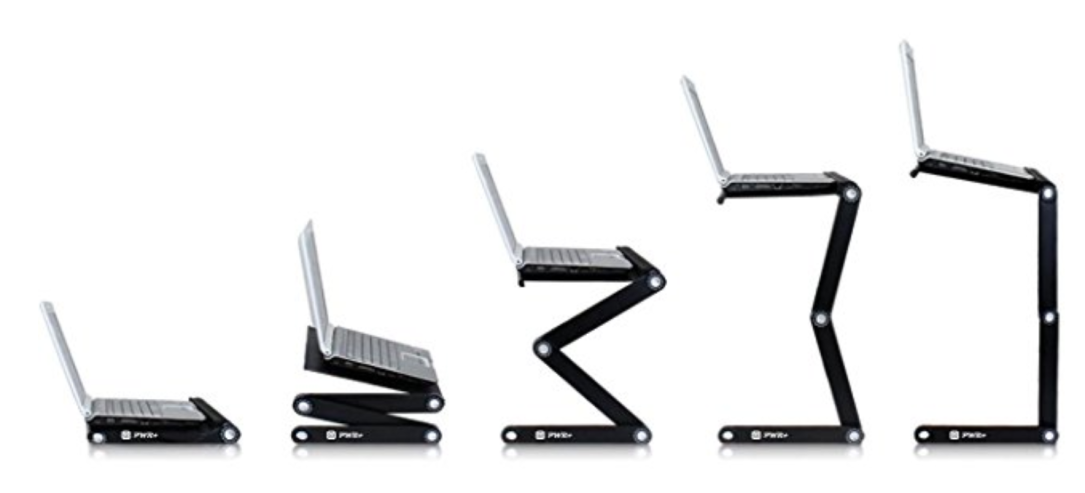
the PWR+ laptop stand.

Yesterday, my constantly-laptop-typing writer friend sent me an email – she had started to feel pain in her hands and arms and was growing alarmed that it might be the beginnings of a repetitive stress injury like the ones I had suffered. Had I ever felt her particular type of pain? Not exactly. But mine was similar enough that I felt compelled to swoop in with recommendations. After nearly two years with vaguely-diagnosable yet completely debilitating pains, I feel like something of an expert. You need a doctor? A physical therapist? An occupational therapist? An acupuncturist who takes insurance? A chiropractor? I can shuffle my stack of medical business cards like a Vegas magician: were you thinking of a massage therapist who also knows reiki? My audience volunteer gasps, YES, I do need one of those!


Where was I? Oh yes. So I resisted the urge to send this friend a 10,000 word email listing everything I have tried for my injuries. Instead, I will share them with you. I guess it would only be fair for me to forward her the link as well, since she inspired this post.

DISCLAIMER: I am NOT a doctor (insert testimonial about consulting your doctor…I am not legally responsible for what happens to you after reading this). I am, however, an informed consumer, so allow me to share some of my favorite tools with you. Oh, and I am not getting any commission here – these are actually the things I use.

ERGONOMICS

  • A laptop stand. Mine has three adjustable hinges and an adorable, removable mouse stand. It can be used as a standing desk, a keyboard rest for an existing monitor setup, or as a monitor stand. Plus it folds! And it weighs only 3.9 pounds!
  • An ergonomic split keyboard. I use the Microsoft Sculpt one with a detached keypad to activate a calculator on your screen. It keeps your arms parallel to  reduce strain on forearm muscles.
  • A decent wireless mouseI use the Logitech M185. I also have the Logitech wireless touchpad, which is like a larger version of the laptop trackpad. It’s good for navigating and zooming but less good for graphic work. I’m considering a vertical mouse, but haven’t made the leap yet.
  • A bean bag wrist wrest. I use the Ergo beads wrist rest to keep my wrists in perfect position for mousing.
  • An memory foam ass pad. Yes, I said ass pad. I have this chair pad. If you must sit at all, this will make it less hurty.

BRACES

  • I was slouching all over the place until I got a back brace. Fatigue can result in sloppy slouches. It is not ideal to use a brace instead of core strength, but the Shark Tank-featured BetterBack brace is really great for this.
  • Wrist splints. I wear these at night to prevent numb hands in the morning. It’s not exactly sexy, but neither is not being able to move your hands.

MUSCLE RELIEF

  • A neck heating pad. OMG. I cannot say enough about this. I got one as a gift from a coworker two years ago and have been using it every day since. I warm my neck up in the morning and again at night before doing my stretches. If you’re particularly crafty, as my mother is, you could make one from cherry pits (she actually bought a barrel of these). The one she gave me smells so good and gives off moist warmth. I overheated a burn hole it in the microwave one day, but salvaged the cherries and sewed a new one.
  • A peanut roller. What? It’s basically two lacrosse balls joined like a mini barbell. I roll it over my hands and forearms after typing for too long.
  • A foam roller. I use this every morning – it’s a packable size and less squishy then the fat pool noodle foam ones.  It offers a satisfying crack and pop as I roll my back over it

BOOK

  • Deskbound book . This one was recommended to me by my physical therapist. It’s a textbook, but written so lay people can understand it. If you’re looking for exercises to build or stretch those muscles after desk work, it is definitely worth the investment.

I hope these help! If you have any other go-to tools, send them my way!
DIY, My story, Work tools

conduit, curtains, and containers

img_3245
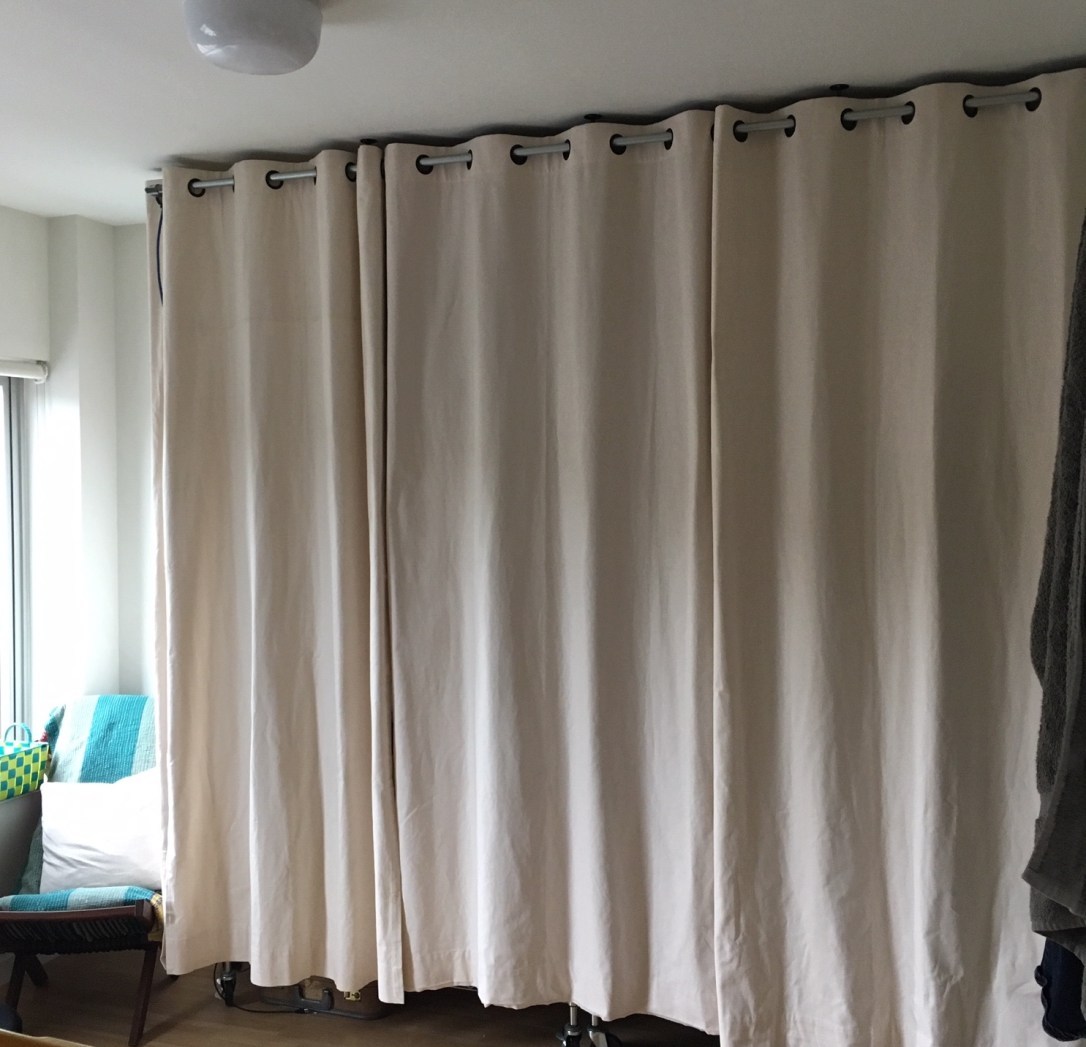
10 years in the making. They’re a little wrinkly, but I’ll steam them!

You DEFINITELY don’t see this in Florida! a poofy-haired tourist-lady exclaimed as I boarded the uptown C train at 23rd street. She was referring to the two ten-foot steel pipes that I had just  threaded through the feet of the bewildered passengers. That’s right! I responded. I gotta get these things home, and they won’t fit in a cab. It was almost Christmas, so people were feeling festively forgiving.

What the hell was I doing on the C train (and after transferring at 168th street, also the A train) with 20 combined feet of hollow galvanized steel conduit pipe, you might ask?

You see, for the past ten years, I have stored my hoarder-caliber inventory of craft supplies on steel industrial shelves that covered an entire wall of my apartment. The shelves are stacked with Giant Rubbermaid tubs stuffed with fabric, felt, and fleece, and smaller shoe-box bins, containing an assortment of tape, ribbon, wire, or paint (labeled accordingly, of course). I also have wooden IKEA drawers that have survived all of my moves since college, with entire compartments devoted to scissors and rulers from the giddy summer Staples trips of my teaching days. The smallest containers, nestled in a plastic hardware organizer, house bobbins, buttons, jewelry findings, and googly eyes. You need glitter? There’s a drawer for that. Glue sticks? I’ve got you covered.

My boxes and bins do serve a purpose, but they are ugly. Thus, my ongoing design dilemma: I need to keep my supplies visible enough that I remember to use them, but also hidden when I’m not. For almost a decade, I’ve been complaining that I wanted to mount a curtain rod from the ceiling to hide the mess, but despite the fact that I have curated dozens of Pinterest boards for inspiration, I couldn’t commit to do the work to make it happen. I was determined to make my clutter-curing curtain dreams a reality before the end of 2018. It was my Old Year’s resolution.

Determined, I did my research, learning about conduit electrical pipe and iron flanges (flanges—what an awesome word!) and screw-set mounts and elbow joints that would make the project work. The supplies cost less than $75, because we already had the hand-me-down curtains (Thanks, Mom. Yes, I know they came from Pottery Barn. Yes, I know they were expensive!). My husband agreed: we would complete the project during the otherwise lazy week between Christmas and New Year’s.

Delirious from a two-day sinus infection but determined to complete the project, I went to Home Depot to pick up my materials. That was straightforward enough, but things got tricky the moment I tried to leave. I was buying two 10-foot steel pipes, which I planned to transport by myself from 23rd Street back to 204th Street. On the subway.

I somehow managed to get my cargo home without incident, and we hung the curtains without hurting ourselves or each other. Now I can make messy art and hide it when I need to do a video call for work. It’s a win-win for me, and I gave a poofy-haired lady a good story to take back to Florida.

My story

(My) Life of Pi(e)

my-time-pie.jpg
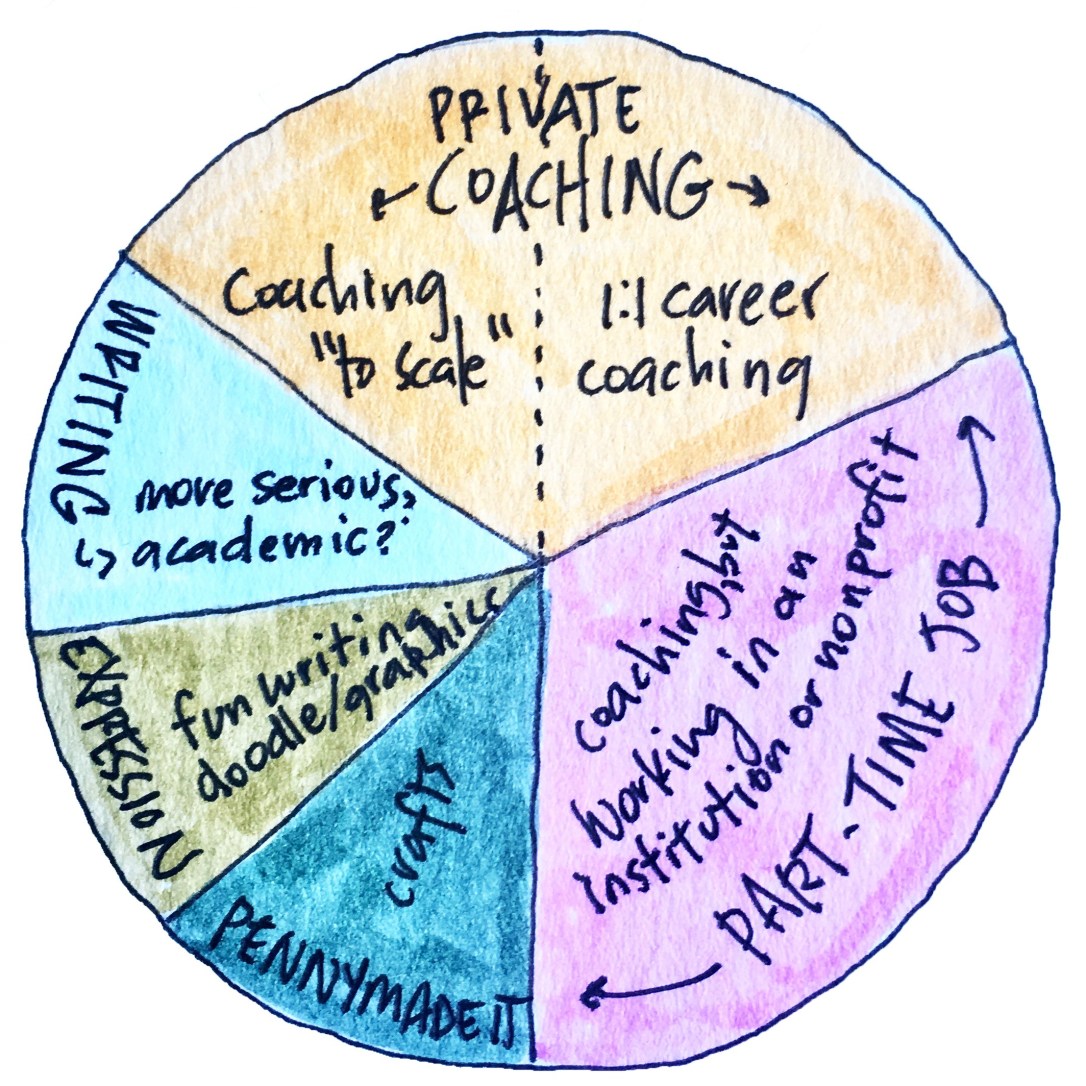
(my) life of pi(e), a diagram of my ideal future.

This past weekend, we met up with a friend of my husband’s who he hasn’t seen since before we got married. After the logistical urban nightmare of agreeing on a place where we would meet (via email during her intermittent periods of wifi access), we gave up and squeezed ourselves into a tiny corner table at a cafe. We sat with our teapots, barely able to hear ourselves between the cacophony of a dad attempting to read a Madeline story to his fidgety daughter and a group of parents bemoaning the city’s competitive high school selection process.

The friend miraculously managed to find us (which is good, because we were not planning to go back out into the cold), and, after the introductions and pleasantries, she triumphantly unfurled her map of midtown, eagerly asking “So, where do you guys live?” We pointed to the place way off the map that would indicate our neighborhood, a full 130 blocks north of our current location. Then she asked where our respective commutes took us each day. My husband pointed smack in the center of the map: midtown. Then he smiled at me—he knew my answer would take a minute. Or twenty.

Unless I have class, I usually commute a full twenty feet to my home office these days, but there is something about saying this that still feels like defeat. Even though I am working with more focus than I ever have these days, It’s still easier to frame my answer in terms of where I used to work when I had a full-time job; it’s just an easier narrative for people to hear. I see her face turn into a question mark as I give my elevator speech about Narrative Medicine and my plans beyond graduation. So you’re doing career coaching for people who have chronic illness? Yes, that is my specialty, but I work with others as well. My proud husband chimed in with my various other projects: daily graphic medicine illustrations, volunteering with a hospice organization, working as part of the volunteer collective in my neighborhood bookstore, and co-writing and illustrating a children’s book. When he mentioned our craft business, I wondered whether she was thinking, “Wow, this woman has a lot of interests!” or “Damn, why can’t this woman decide what the hell her focus is?”

The judgment is mine, not hers, I am sure.

Why do I care so much, and what would it say about me if both of these things were equally true? Of course I want to make a good first impression on my husband’s friend. Almost four months post full-time employment, I’m still getting used to explaining what it is that I currently do. It was so much easier when I had a full-time job and thus, a quick answer: “I’m a teacher.” “I work in a startup.” “I work at a university.” Even “I’m a student” is fully true, but it doesn’t actually account for all that I am and how I spend the majority of my time. But people I’m just meeting don’t need to know all of this, anyway!

I have been so programmed to believe that if I am not producing, not earning at my maximum capacity, I am not contributing. But this is not fully true. I feel a greater sense of connection, satisfaction, and meaning from my six hours per week spent volunteering than I ever I did from sitting at a desk for 40-plus hours. What’s a better way to answer this what-do-you-do question? I could start with I am a teacher, a writer, an artist, and a coach, and talk about one of my projects. The story gets a little easier each time I tell it. I just have to keep talking.

And that diagram at the top of this post? That’s how I plan to divide my time once I’m done with school. Pie charts don’t have to be made with Excel, you know…


Productivity

Setting a morning routine


plancard
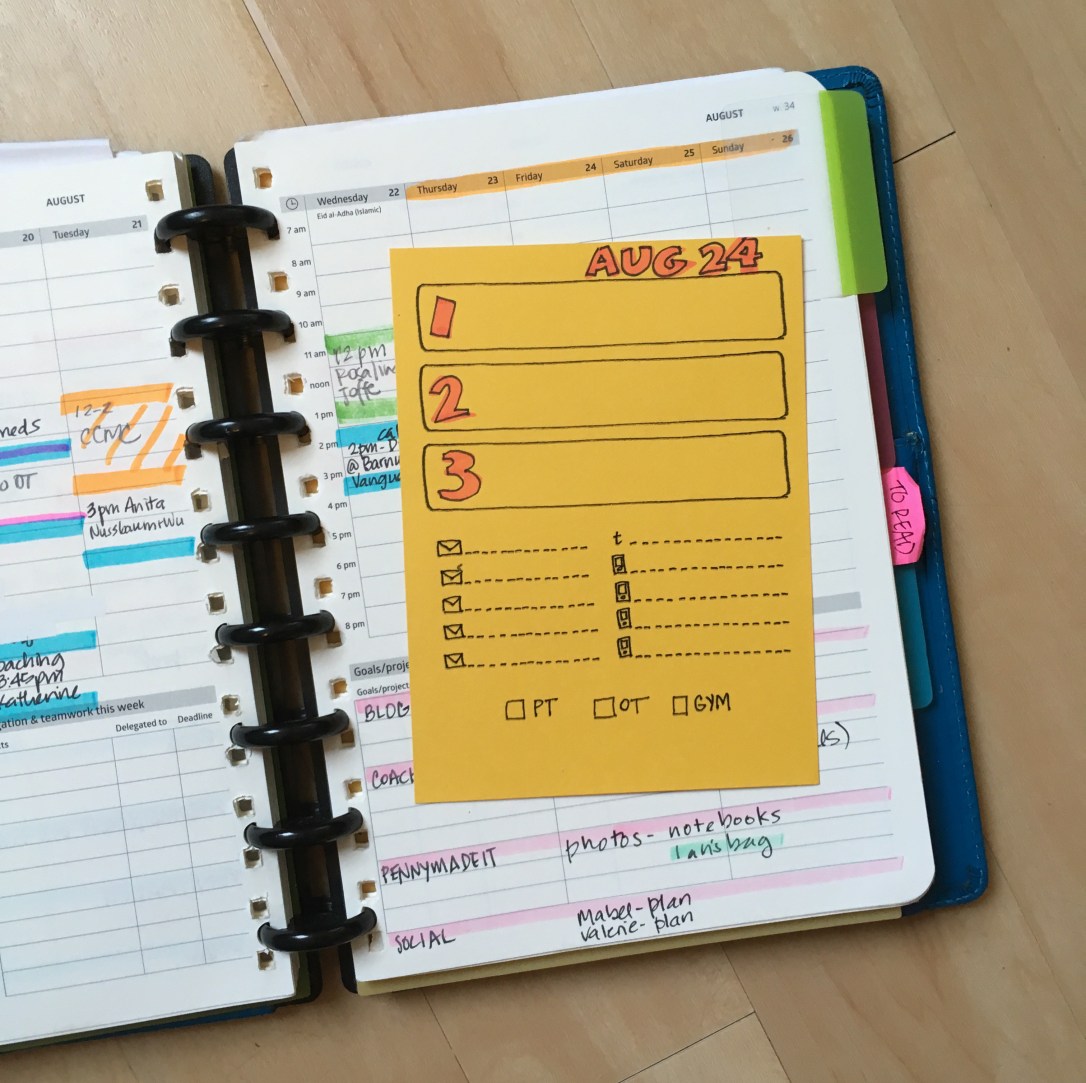
my top three tasks card

Before I could enjoy my very first Monday after leaving my job, I was already consumed with a new project: how to organize my time. Suddenly, the lines between work-me, student-me, and social-me were blurred. What was I going to do with no one telling me what to do?

If you’re going to leave your day job but know you are most productive when your days have structure, you have to be vigilant about establishing routines. I have spent the past six weeks trying to figure out the best method of managing my time, and the most important thing I have learned is to develop a morning ritual and stick to it. 

Here’s what mine looks like:

  • 6:00 – PT exercises
  • 6:30 – free writing/breakfast. I set a timer for 30 minutes and write while I eat. This writing doesn’t have any particular purpose; I’m just getting ideas out of so they don’t distract me all day.  When I go back to my notebook, I often find little tidbits that might inform a future project.
  • 7:00 – calendar review; fill in my index card with my top three tasks and follow-up emails or calls; schedule tasks in planner (you can find my template here).
  • 7:15 – writing sprint – I set my timer for 45 minutes and work on a writing project
  • 8:00 – check email.  I like to hold off as long as possible on checking email, and two hours is my limit. Besides, anyone who has a 9-to-5 job is not even in the office yet.
  • 8:15 – writing sprint
  • 9:00 – gym

Some of you may be thinking this schedule looks like your personal version of hell, but it worked for me. The underlying premise is that tasks that don’t get scheduled are harder to do, and we tend to underestimate how long it takes to do things.  For now, this method is working for me.

Crap! it’s after 9 o’clock – I’m late for the gym!