Productivity, Support System, Work tools

How to be your story’s protagonist

levelupImagine creating a secret identity for yourself, and now you are strong and brave and unafraid. You are resourceful, ready to vanquish enemies. You are part of a worldwide tribe that energizes and supports you. You are doing things you never thought possible and feel exhilarated and challenged. You are mastering—not enduring—life!  Sounds pretty good, right?

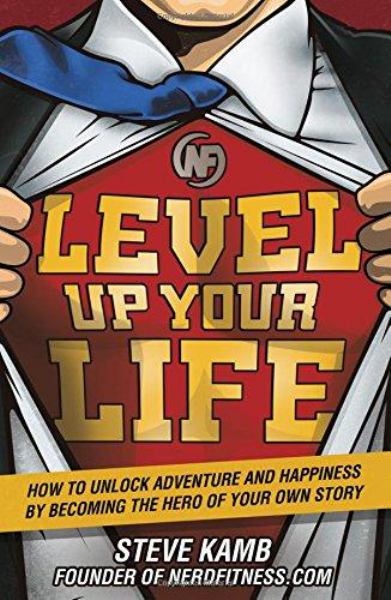
A few weeks ago, I was browsing the shelves at the public library and found Steve Kamb’s 2016 book Level Up your Life. The subtitle reads: How to Unlock Adventure and Happiness by Becoming the Hero of your Own Story.  A book combining narrative and agency to help people reach their goals? He has my attention.

The cover depicts a comic book-style illustration of a man ripping off his business shirt and tie to reveal his (six-pack abs and his) superhero costume. Our hero is answering a call to action; someone, somewhere, is in distress. Kamb does not need to rescue us readers, however. He offers an adaptable blueprint so that we can save ourselves. With a little imagination and discipline, even the humblest of nerdy office drones can take charge of her life, break free from being ordinary, and join this Rebellion. And she can have a lot of fun while doing so.

Kamb, the founder of nerdfitness.com, is a self-proclaimed formerly “risk-averse, picky eating introvert who felt more at home in front of a computer than in public.” He was happy enough in his post-college job, but was vaguely dissatisfied. After moving cross-country for a more interesting, but lower-paying job, he realized that he was still wasting his evenings and weekends drinking and playing video games to numb himself from his uninspiring life. He wanted a challenge, so he began with getting fit.

Kamb recontextualized his fitness quest as a game: he developed an origin story, an alter ego identity, and a series of increasingly more difficult challenges (in video games, this is known as leveling up). Once he began to see actual results from his workouts, he decided to help other nerds do the same by using game theory. He put his own video games aside, and for the next 18 months, devoted that same energy to building an online community. Then, he applied his method to other areas of his life. He knew he was onto something.

What I love about this book is that it is not just one guy bragging about how cool his life is now, how he is traveled to blah blah countries and done blah blah cool things. He makes leveling up accessible, encouraging his readers to start small while challenging them to play on increasingly difficult levels. Because he is a nerd, Kamb sprinkles references to video games and fantasy and science fiction characters throughout the book. He also builds his hero’s journey on the work done by Joseph Campbell and Christopher Vogler. Each step has its own chapter.

The main character is somebody of normal existence who goes through a journey that fundamentally changes him or her as a character. This character learns from a mentor, skeptically accepts the call to leave a comfortable existence, faces trials and tribulations, makes allies and enemies, outsmart or wins over the guardians of the threshold, struggles to survive/succeed, transforms, and ultimately returns home with altered/improved outlook on life.

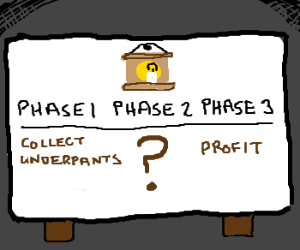
My biggest takeaway from this book is the cautionary tale of the South Park Underpants Gnomes. In the middle of the night, these little elves run around the fictional cartoon town, stealing people’s underpants. When asked why they are doing this, one replies, “Collecting underpants is just Phase 1!” When asked about Phase 2, the gnomes reply with, “Phase 3 is profit!” The gnomes never find out what Phase 2 is. Kamb’s message to his readers: stop mindlessly collecting underpants, or don’t consume yourself with busy work that doesn’t move you toward your goal. You have to  take action in Phase 2, or you will just have a shit-ton of underpants and no profit.

gnomes
Underpants Gnomes from South Park

This idea really hit home for me as I think back to my summer research project. In the beginning, I was obsessed with collecting all available information on my topic. I became a hoarder of articles and blog posts and books, and wasted hours organizing them into an indexed binder. I knew my goal was to write a paper, so why was I wasting my time? At one point, my advisor had to cut me off. She said, “That’s it! No new sources!”
gnome plan
You gotta have a Phase 2.

Damnit,  I thought.  Now I am going to have to do some real work.

Even if you don’t pick up the book, I hope you have learned this from Kamb, from the makers of South Park, and from me: Don’t be an Underpants Gnome.
chronic illness

Being unremarkable

handtaco.jpg
The cat stays in the picture.

I’ve been spending a lot of time thinking about my hands lately. Until now, my latest problem was some kind of muscular problem at the base of my thumb that doesn’t fit any singular diagnosis. After three more months of weekly occupational therapy and twenty minutes a day of hand, finger, and wrist-strengthening exercises, I can go for longer periods using my hands without pain. This is definitely progress. I also don’t type all day anymore, which definitely helps.

Now I have a new ailment to add to my keychain of pain: a knobby swelling of the knuckle on the middle finger on my left hand which feels a lot like osteoarthritis. According to the  radiologist’s report, my X-rays are “unremarkable.” Not even worth talking about. Hmph. All I know is that I wake up every morning feeling swollen and looking freakishly inflamed, like I have a bunion on my finger. Could it still be arthritis, but just not show up on the x-ray? I feel like all of the problems I’ve had with my hands and arms have been this way: not-quite carpal tunnel, not-quite tendinitis, not-quite pinched nerves. Not-quite legitimate.  

I have become quite the complainer.

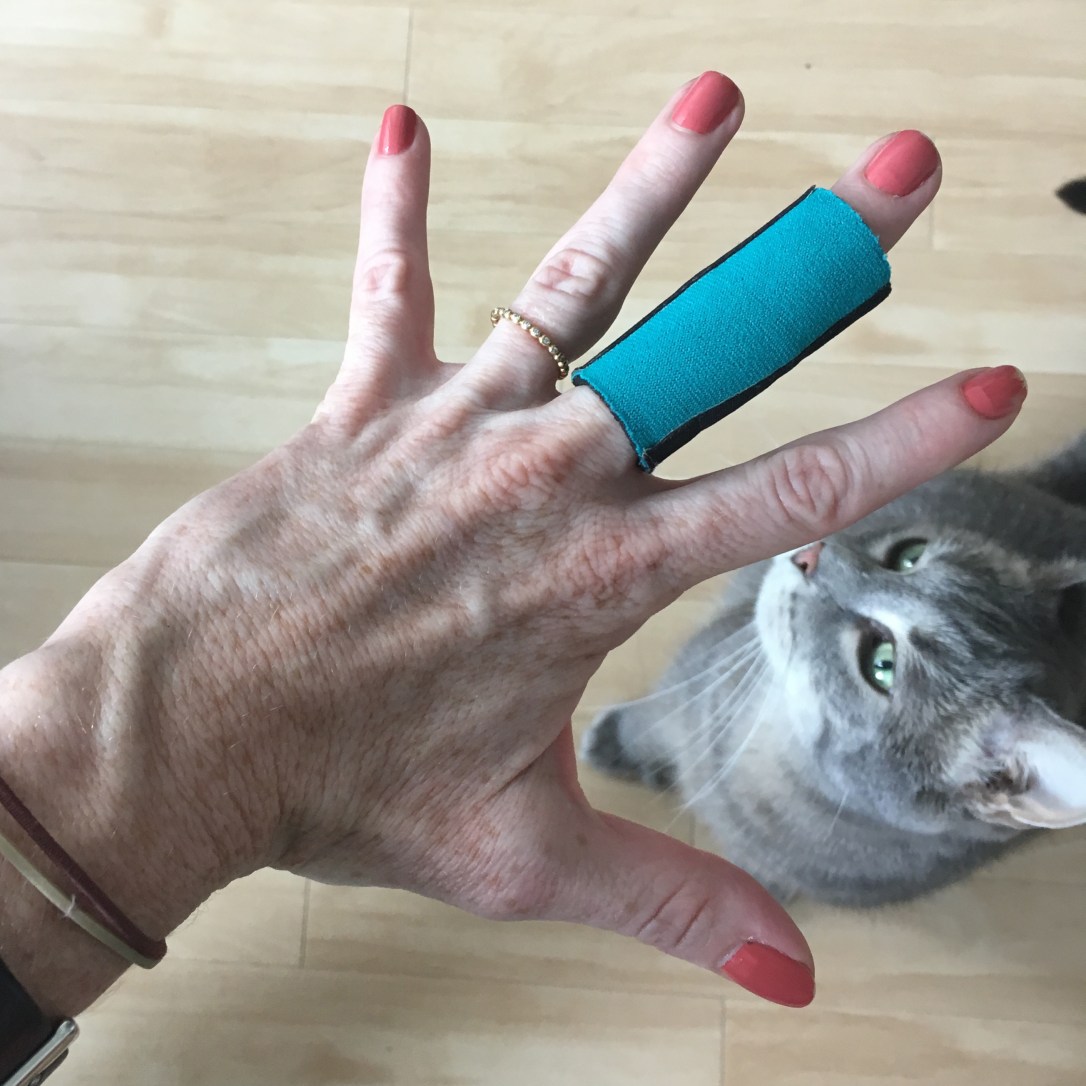
Regardless of the (lack of) diagnosis, we still have to treat the symptoms. In the world of OT, that means more splints. I got a turquoise neoprene finger sleeve to wear at night (I imagine a factory somewhere where workers decapitate gloves, sending the resulting fingerless remnants to weightlifters). When my pain didn’t subside, she made a(nother) custom splint ($230 billed to Blue Cross), shaped like an old 110-film canister, that imprisons my middle finger between its two adjacent fingers. This is supposed to keep me from overextending it. Instead, it mainly restricts my ability to use my left hand and cuts off the circulation to my pointer finger.

My problem, they all say, is that I’m hypermobile. Allegedly my joints are very flexible and I can hold myself in unhealthy postures to compensate for muscle weakness and bad posture, even in my hands. Giving me a splint usually means that my body will just create a workaround that will do even more damage. And so, the cycle continues.

It’s kind of funny that my body is set up to unwittingly sabotage my progress. Every time I go to the OT “gym” (where the hardest exercises include picking pennies hidden in of a huge blob of putty), I feel like I am being reprimanded for my hyperflexibility. There’s probably a metaphor in there somewhere. Am I bending to meet everyone else’s needs, instead of making myself stronger?

Hmph.

My story

Here’s my story.

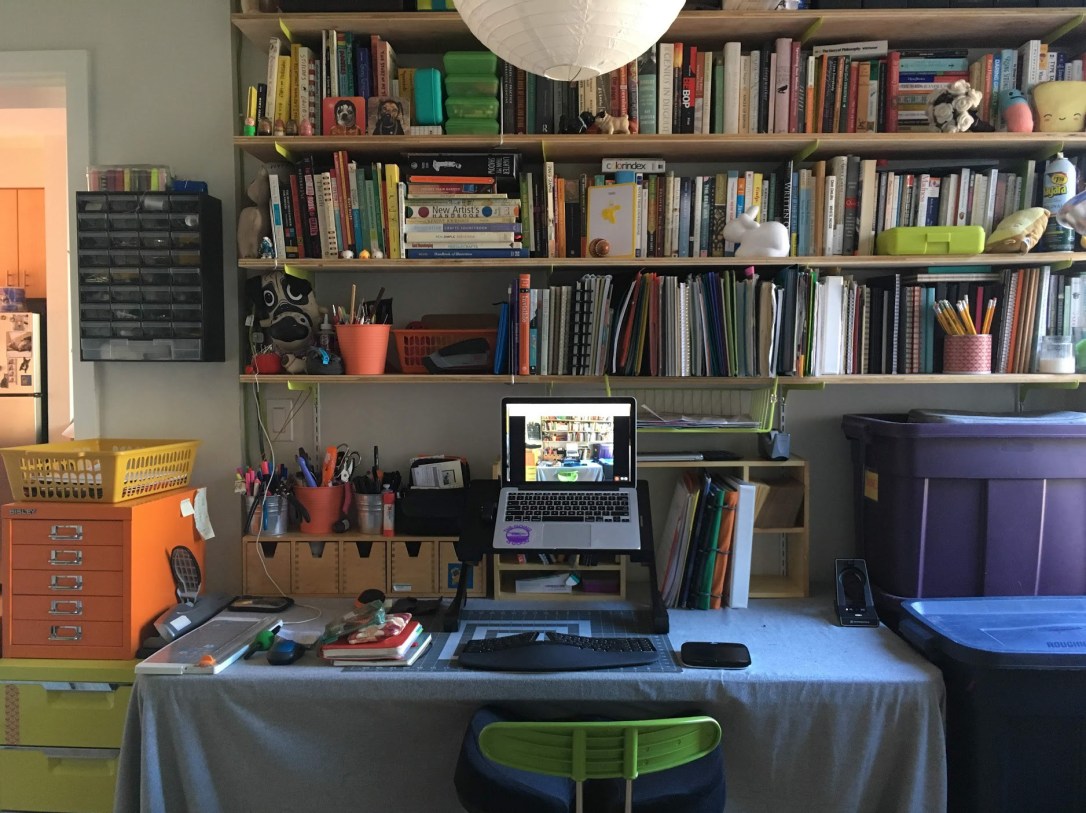
desk-new-2For years, I was perfectly fine with the double life of an office-worker-by-day and artist and student by night. When my hands, wrists, neck and back all went on strike and I lost my ability to type, to write, or to draw, I felt completely useless. I was in constant pain and I blamed myself for not getting better. Maybe this was more than just a physical issue, I wondered. Is it work itself that’s making me unhappy? After a year of deliberation, I made a radical change.

I quit my job.

That’s right. I ended up becoming so obsessed with the idea of sustainable, meaningful work that I actually left my job to study it. As my body began to heal, I asked other women about their work lives, and heard stories of otherwise high-achieving women who were happy enough, but who had this other thing that they really wanted to do. In some cases, it was a creative side project; in others, it was a complete career overhaul. I suddenly realized: these are the people I need to serve.

Keep scrolling to hear about my process.

Alienated Labor

Ikiru, Busy Work and Bullshit Jobs

I’ve been thinking a lot about “busy work” lately…


ikiru-cover
Our protagonist.

I just watched Kurosawa’s 1952 film, Ikiru. Kanji Wantanabe, the film’s protagonist and a Japanese public affairs section chief whose main responsibility seems to be (literally) rubber-stamping proposals, learns that he is dying of stomach cancer. The man, who had never taken a vacation or a sick day in his 25 years of service, does not know how much longer he has, and overhears his son and daughter–in-law planning to spend his retirement money and pension on a new house. Kenji leaves his home and his job, withdraws his retirement bonus, and befriends a novelist who takes him on an improvised tour of the city’s pachinko parlors and speakeasies. Later, he encounters Toyo, a vibrant and spirited young former employee who leaves her paper-pushing desk job to take a job assembling animated stuffed toy bunnies. She may be a lowly factory worker, but she can at least see the value in her work: bringing happiness to kids.

Ikiru, which translates into English as “to live,” is less about a man dying than about a man’s desire  for a sense of purpose in his remaining days. He becomes a champion of a group of local mothers who have been petitioning, to no avail, to turn a hazardous liquid waste site into a park for their kids. Until Kenji gets involved, this gaggle of mild-mannered women (who serve as the embodiment of failed not-my-job bureaucracy), dutifully go from office to office to plead their case until they reach a breaking point, unleashing a tirade on the clerk who had taken their initial complaint and sent them in circles.

Without giving any further spoilers, the film’s work-worn archetypal hero’s plight can be seen in fiction: Bartleby the Scrivener and The Death of Ivan Illych, and in modern films: Office Space, Up in the Air, and Zootopia (Remember that DMV sloth?). TV is riddled with them: The Office (obviously), Workaholics, The IT Crowd, and Silicon Valley.

Why are these sad working stiffs so relatable?  They seem to have what David Graeber, anthropologist from the London School of Economics, would call “bullshitjobs. Graeber received such an overwhelming response to his  essay on this topic that he wrote an entire book about it. Just what constitutes a bullshit job? On the September 3 podcast of The Hidden Brain, Graeber tells host Shankar Vadantham that “between 37 and 40% of all people who had jobs were convinced that if their job didn’t exist, it would make no difference at all.”  These jobs are not usually menial, as you might expect—they’re “clerical, managerial, administrative sort of positions… or marketing [or] human resources…[workers who would] really rather be doing something useful with their lives.”


bullshit job.jpg
from Simon & Schuster

Graeber explained how he was first introduced to “bullshit” at work: as a teenager, he was a dishwasher. Eager to get the dishes done so he could relax, he and his friend worked quickly and efficiently and then took a break. The boss, finding the two boys loafing, protested, yelling, “You’re on MY time, and you can’t loaf around!” This idea, of someone purchasing or renting our time, is one that didn’t always exist until the Industrial Era. Heidegger and Marx saw it coming. When we’re so removed from actually making decorative or utilitarian objects, as artisans and craftsmen once did, it becomes harder to see the value in the work we are doing.

Graeber divides classifies bullshit jobs as follows:

  1. Flunkies who make their boss feel important
  2. Goons who act aggressively on behalf of their bosses or clients (this includes lawyers)
  3. Duct tapers hide a problem rather than fixing it (he gives the example of an administrator who takes messages for a single repair person who is overburdened. This guy’s whole job is to apologize for his boss. Wouldn’t it be more efficient, Graeber asks, to just hire another technician?
  4. Box-Tickers create paperwork rather than take action
  5. Taskmasters create meaningless work for their subordinates in order to have a mechanism to evaluate them:
    1. Supervisors of people who don’t need supervision
    2. People who create paperwork and other unnecessary tasks (he sees this as a huge problem in universities, where administrative staff outnumber faculty, and where high-level administrators are assigned multiple assistants).

Are there any jobs that are bullshit-proof?  I think I’m creating one —I’ll keep you posted.

My story, Support System

Five simple questions

where-going.pngI learned today that my greatest strength is that I keep going like the Energizer Bunny, and that my greatest weakness is that I overthink things. I learned these things by asking a few questions to the right people.

Last week, while I was hoofing it on the elliptical at the gym, I was listening to one of my favorite podcasts: How to Be Awesome at your Job. The host, Pete Mockaitis, was interviewing Maxie McCoy, women’s leadership speaker and author of You’re Not Lost: an Inspired Action Plan for Finding Your Own Way. Through speaking with hundreds of women, McCoy heard several recurring questions: “Am I doing the right things? Is what I’m feeling normal? How do I handle this doubt? Where the heck am I going with my life?” She wants to reassure us:

You don’t have to know where you’re going in order to begin … we can find our way when we tap into a really deep sense of self-belief in order to take small step after small step after small step.

So how do we figure out which steps to take? McCoy says the first questions to ask are “What energizes you?” and “Where have you felt the most proud, energized, and connected to power?” Once you answer these questions, she wants you to ask yourself why. Do this three times. Then, she says, start taking steps to create action, no matter how insignificant the action may seem.

Back when I was feeling a little uninspired at work, I would come home and crochet for hours. What is it about crochet that brings me joy? Memories of sitting next to my grandmother, who would remind me not to make my stitches too tight. Expressing my creativity. Making things that would provide warmth and comfort to others. The next question to ask would be: what actions could I take to get more of that feeling in my life? By gravitating toward these I would be paving my own path as I’m traveling along it. Baby steps.

At the end of the episode, McCoy mentions a fabulous exercise that you can try to identify where you have the most energy (added bonus: you’ll get a boost if you’re feeling a bit lost): surveying people in your support system.

Here are the questions that she uses:

  1. Why am I irreplaceable?
  2. What is my superpower?
  3. What is holding me back?
  4. Where will I be in five years?
  5. What are my talents, potential, and unique value?

McCoy had one friend collect and tabulate these responses, and present them in person (without attribution) to her. When I tried this, I switched it up a little bit, emailing a handful of friends and family who know me well. Because I knew this exercise would take some time, I thought it would only be fair if I reciprocated. If we keep going, we’ll create a veritable Amway pyramid scheme of empowerment! What resulted for me were some really insightful conversations and some very genuine expressions of gratitude.

Give it a try. This Energizer Bunny thinks you should.